



Envoyez vos Photos et vidéos
Images | vidéos | Timbres, pièces de monnaie, divers | Images Google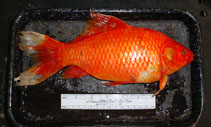 Carassius auratus
Photo de Winter, T.J.
Images | vidéos | Timbres, pièces de monnaie, divers | Images Google
Photo de Winter, T.J.
Classification / Noms Noms communs | Synonymes | Catalog of Fishes(Genre, Espèce) | ITIS | CoL | WoRMS | Cloffa
> Cypriniformes (Carps) > Cyprinidae (Minnows or carps) > Cyprininae
Etymology: Carassius: Latinization of , karass, karausche, European crucian carp (Ref. 45335); auratus: From the words carassius--Latin of karass (common name for these fishes in Eurasia) and auratus, meaning gilded (Ref. 10294).
More on author: Linnaeus.
Etymology: Carassius: Latinization of , karass, karausche, European crucian carp (Ref. 45335); auratus: From the words carassius--Latin of karass (common name for these fishes in Eurasia) and auratus, meaning gilded (Ref. 10294).
More on author: Linnaeus.
Environnement : milieu / zone climatique / profondeur / gamme de distribution Écologie
; eau douce; saumâtre benthopélagique; pH range: 6.0 - 8.0; dH range: 5 - 19; potamodrome (Ref. 126106); profondeur 0 - 20 m (Ref. 6898). Subtropical; 0°C - 41°C (Ref. 35682); 53°N - 22°N
Distribution Territoires | Zones FAO | Écosystèmes | Occurrences | Carte par point | Introductions | Faunafri
Asia: native in East Asia, China and Japan (Ref. 6390). Introduced elsewhere. throughout the world with reported adverse ecological impact after introduction.
Taille / Poids / Âge
Maturité: Lm ? range ? - ? cm
Max length : 48.0 cm TL mâle / non sexé; (Ref. 27549); common length : 10.0 cm TL mâle / non sexé; (Ref. 9987); poids max. publié: 1.6 kg (Ref. 128900); âge max. reporté: 41 années (Ref. 72468)
Max length : 48.0 cm TL mâle / non sexé; (Ref. 27549); common length : 10.0 cm TL mâle / non sexé; (Ref. 9987); poids max. publié: 1.6 kg (Ref. 128900); âge max. reporté: 41 années (Ref. 72468)
Description synthétique Clés d'identification | Morphologie | Morphométrie
Épines dorsales (Total) : 3 - 4; Rayons mous dorsaux (Total) : 14 - 20; Épines anales: 2 - 3; Rayons mous anaux: 4 - 7; Vertèbres: 30. Body stout, thick-set, caudal peduncle thick and short (Ref. 1998). Head without scales (Ref. 39167, 1998), broadly triangular (Ref. 1998), interorbital space broad, snout longer than eye diameter, maxillary reaching posterior nostril or not quite to eye (Ref. 39166), barbels lacking on upper jaw (Ref. 39104, 1998). Lateral line complete. Dorsal and anal fins with serrate bony spines, pelvic fins short, broad and thoracic. Nuptial tubercles of male fine, on opercle, sometimes on back and a few on pectoral fins. Hybridize readily with carp, hybrids intermediate in most characteristics (Ref. 1998). Caudal fin with 17-19 rays (Ref. 2196). Last simple anal ray osseous and serrated posteriorly; no barbels (Ref. 43281). Pigmentation: Wild-caught specimens, olive brown (Ref. 39168, 39104), slate olive, olive green, with a bronze sheen (Ref. 39104), silvery, grayish yellowish, gray-silver (Ref. 39169), through gold (often with black blotches) to creamy white (Ref. 1998); yellowish white or white below. Cultured forms vary through scarlet, red-pink, silver, brown, white, black and combinations of these colors (Ref. 39104).
Body shape (shape guide): fusiform / normal; Cross section: oval.
Body shape (shape guide): fusiform / normal; Cross section: oval.
Adults inhabit rivers, lakes, ponds and ditches (Ref. 5258, 10294) with stagnant or slow-flowing water (Ref. 30578). They occur in eutrophic waters, well vegetated ponds and canals (Ref. 59043). Live better in cold water. Feed mainly on plankton, benthic invertebrates, plant material and detritus (Ref. 59043). Goldfish lay eggs on submerged vegetation. Females spawn multiple times during the spawning period (Ref. 88808). Oviparous, with pelagic larvae. They last long in captivity (Ref. 7248). Maximum recorded salinity is 17 ppt (Ref. 39171), but unable to withstand prolonged exposure above 15 ppt (Ref. 39172, 39174). Used as an experimental species (Ref. 4537). Valued as ornamental fish for ponds and aquaria; edible but rarely eaten (Ref. 9987). Aquarium keeping: in groups of 5 or more individuals; minimum aquarium size 100 cm (Ref. 51539). Reported individual hooked by an angler in a lake in Poole, Dorset measured 40 cm (16 in), weighing 2.3 kg (Practical Fishkeeping, 2010).
Cycle de vie et comportement reproducteur Maturité | Reproduction | Frai | Œufs | Fécondité | Larves
Cold water temperatures during the winter months are necessary for proper ova development (Ref. 44091). Spawning takes place in shallow water among weeds, often where willow roots grow exposed in water (Ref. 39171), also meadows inundated by spring flood (Ref. 39176). Spawning activity begin just before dawn (Ref. 39168), to midafternoon (Ref. 39177). Individual fish spawn 3-10 lots of eggs at intervals of 8-10 days (Ref. 39180). Juveniles need high temperature to grow. Eggs are sticky, attached to water plants or submerged objects (Ref. 59043). Females spawn multiple times during the spawning period (Ref. 88808).
Référence principale
Téléchargez vos références | Références | Coordinateur | Collaborateurs
Kottelat, M., A.J. Whitten, S.N. Kartikasari and S. Wirjoatmodjo, 1993. Freshwater fishes of Western Indonesia and Sulawesi. Periplus Editions, Hong Kong. 221 p. (Ref. 7050)
Statut dans la liste rouge de l'IUCN (Ref. 130435: Version 2025-2 (Global))
Préoccupation mineure (LC) ; Date assessed: 04 August 2010
CITES
Not Evaluated
Menace pour l'homme
Potential pest
Utilisations par l'homme
Pêcheries: commercial; Aquaculture: commercial; pêche sportive: oui; Aquarium: hautement commercial; appât: occasionally
FAO - Systèmes d'aquaculture: production; pêcheries: débarquements; Publication: search | FishSource |
Plus d'informations
Écologie trophique
Aliments (proies)
Composition du régime alimentaire
Consommation alimentaire
Rations alimentaires
Prédateurs
Aliments (proies)
Composition du régime alimentaire
Consommation alimentaire
Rations alimentaires
Prédateurs
Dynamique des populations
Paramètres de croissance
Âges / tailles maximales
Longueur-poids rel.
Rel. longueur-longueur.
Fréquences de longueurs
Conversion de masse
Recrutement
Abondance
Paramètres de croissance
Âges / tailles maximales
Longueur-poids rel.
Rel. longueur-longueur.
Fréquences de longueurs
Conversion de masse
Recrutement
Abondance
Physiologie
Composition corporelle
Nutriments
Consommation d'oxygène
Type de natation
Vitesse de nage
Pigments visuels
Son de poisson
Maladies et parasites
Toxicité (CL50)
Composition corporelle
Nutriments
Consommation d'oxygène
Type de natation
Vitesse de nage
Pigments visuels
Son de poisson
Maladies et parasites
Toxicité (CL50)
Liées à l'homme
Systèmes d'aquaculture
Profils d'aquaculture
Souches
Cas de ciguatera
Timbres, pièces de monnaie, divers
Systèmes d'aquaculture
Profils d'aquaculture
Souches
Cas de ciguatera
Timbres, pièces de monnaie, divers
Outils
Quiz bio | E-book | Guide de terrain | Clés d'identification | Générateur de fréquences de longueur | Outil de dynamique de population | Carte par point |
Capture-MSY |
Articles particuliers
Télécharger en XML
Sources Internet
AFORO (otoliths) | Alien/Invasive Species database | Aquatic Commons | BHL | Cloffa | Websites from users | FishWatcher | CISTI | Catalog of Fishes: Genre, Espèce | DiscoverLife | ECOTOX | FAO - Systèmes d'aquaculture: production; pêcheries: débarquements; Publication: search | Faunafri | Fishipedia | Fishtrace | GloBI | Google Books | Google Scholar | Google | IGFA World Record | Bases de données nationales | OneZoom | Open Tree of Life | Otolith Atlas of Taiwan Fishes | Aquariums publics | PubMed | Reef Life Survey | Socotra Atlas | TreeBase | Arbre de Vie | Wikipedia: aller à, chercher | World Records Freshwater Fishing | Zoological Record
Estimations basées sur des modèles
Indice de diversité phylogénétique (Réf. 82804): PD50 = 0.5156 [Uniqueness, from 0.5 = low to 2.0 = high].
Bayesian length-weight: a=0.01259 (0.01083 - 0.01464), b=3.04 (3.00 - 3.08), in cm total length, based on LWR estimates for this species (Ref. 93245).
Niveau trophique (Réf. 69278): 2.0 ±0.0 se; based on diet studies.
Generation time: 6.7 ( na - na) years. Estimated as median ln(3)/K based on 2 growth studies.
Résilience (Réf. 120179): Milieu, temps minimum de doublement de population : 1,4 à 4,4 années (K=0.17; tm=1; tmax=30).