



Добавить Ваши наблюдения в Fish Watcher
| Native range | All suitable habitat | Point map | Year 2050 |

|
| This map was computer-generated and has not yet been reviewed. |
| Lycodes diapterus AquaMaps Data sources: GBIF OBIS |
Загрузить свой Фото и Видео
изображения | Изображение на Google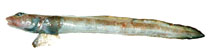 Lycodes diapterus
Изображение сделано Orlov, A.
изображения | Изображение на Google
Изображение сделано Orlov, A.
Классификация / Имена народные названия | синонимы | Catalog of Fishes(род, виды) | ITIS | CoL | WoRMS | Cloffa
> Perciformes/Zoarcoidei (Eelpouts and pricklebacks) > Zoarcidae (Eelpouts) > Lycodinae
Etymology: Lycodes: Greek, lykos = wolf + Greek, suffix, oides = similar to (Ref. 45335); diapterus: From the Greek di and apteros meaning 'two' and 'fin' (Ref. 27436).
More on author: Gilbert.
Etymology: Lycodes: Greek, lykos = wolf + Greek, suffix, oides = similar to (Ref. 45335); diapterus: From the Greek di and apteros meaning 'two' and 'fin' (Ref. 27436).
More on author: Gilbert.
Окружающая среда: среда / климатическая зона / пределы глубины / диапазон распространения экология
морской батидемерсальный; пределы глубины 146 - 844 m (Ref. 80505), usually 300 - 600 m (Ref. 80505). Deep-water
распространение Территории | регионы FAO | Экосистемы | места находок | карта точек | интродукции | Faunafri
North Pacific: Southern California west of the Channel Islands north along the North American coast to the Pacific side of Vancouver Island; apparently not present in the Strait of Georgia or Puget Sound, and has been reported as far south as San Diego.
Размер / Вес / Возраст
Краткое описание определительные ключи | морфология | морфометрия
колючие лучи спинного плавника (общее число) : 0; членистые (мягкие) лучи спинного плавника (общее число) : 109 - 118; колючие лучи анального плавника: 0; членистые (мягкие) лучи анального плавника: 99 - 109; позвонки: 118 - 126. This species is distinguished by the following: with scales covering the nape and the entire postorbital dorsal surface of the head (in adults 15.0 cm SL and larger): it differs from L. beringi in having higher counts of dorsal-fin ray (usually 111 or more), anal-fin ray (usually 100 or more), vertebral (usually 119 or more), and gill raker (usually 15 or more); differs from L. hubbsi in having 19-21 pectoral-fin rays (vs. 20-23), position of the first dorsal-fin
pterygiophore at the sixth or seventh interneural gap (vs. third), and color pattern, for it lacks narrow light bands extending onto dorsal fin and across nape; differs from the 'L. nakamurae group’’ (nakamurae, pectoralis, nishimurai) in having 4 postorbital pores (vs. 1 or 2), the posteriormost without a short tube; lower pectoral-fin lobe rounded, the tips of the rays rounded and the middle rays often branched, fin membrane not incised (vs. pointed, with rays pointed and unbranched, membrane moderately incised); scales often present on base of pectoral fin; light inverted V-shaped bands usually present on body (Ref. 80505).
Body shape (shape guide): eel-like; Cross section: oval.
Body shape (shape guide): eel-like; Cross section: oval.
Found on muddy bottoms (Ref. 2850). May be used as bait (Ref. 27436). Flesh considered firm and tasty but not esteemed (Ref. 27436).
Жизненный цикл и брачное поведение половая зрелость | размножение | нерест | икра | Плодовитость | личинки
Основная ссылка
Загрузите свои рекомендации | ссылки | координатор | соавторы
Anderson, M.E., 1994. Systematics and osteology of the Zoarcidae (Teleostei: Perciformes). Ichthyol. Bull. J.L.B. Smith Inst. Ichthyol. 60:120 p. (Ref. 11954)
CITES
Not Evaluated
Угроза для людей
Harmless
Использование человеком
рыболовство: рыболовство как средство для существования
FAO - Publication: search | FishSource |
дополнительная информация
Трофическая экология
Пищевые предметы (добыча)
состав пищи
потребление пищи
Продовольственные пайки
хищники
Пищевые предметы (добыча)
состав пищи
потребление пищи
Продовольственные пайки
хищники
экология
экология
экология
Динамика численности населения
Параметры роста
Макс. возраст / размер
Отношение длины к весу.
Отношение длины к длине.
Размерный состав
Преобразование массы
пополнение
численность
Параметры роста
Макс. возраст / размер
Отношение длины к весу.
Отношение длины к длине.
Размерный состав
Преобразование массы
пополнение
численность
Жизненный цикл
размножение
половая зрелость
Зрелость/Жиры относительно.
Плодовитость
нерест
Нерестовые скопления
икра
Развитие икры
личинки
динамика численности личинок
размножение
половая зрелость
Зрелость/Жиры относительно.
Плодовитость
нерест
Нерестовые скопления
икра
Развитие икры
личинки
динамика численности личинок
Анатомия
жаберная область
Мозг
Отолит
жаберная область
Мозг
Отолит
Физиология
Состав тела
Питательные вещества
Потребление кислорода
Тип плавания
Скорость плавания
Зрительные пигменты
Звук рыбы
Болезни и паразиты
Токсичность (LC50s)
Состав тела
Питательные вещества
Потребление кислорода
Тип плавания
Скорость плавания
Зрительные пигменты
Звук рыбы
Болезни и паразиты
Токсичность (LC50s)
генетика
Геном
генетика
Гетерозиготность
наследуемость
Генетическое разнообразие
Геном
генетика
Гетерозиготность
наследуемость
Генетическое разнообразие
Связанные с человеком
Системы аквакультуры
особенности рыбоводства
степень растяжения
Случаи заболевания сигуатерой
Марки, монеты и прочее.
Системы аквакультуры
особенности рыбоводства
степень растяжения
Случаи заболевания сигуатерой
Марки, монеты и прочее.
инструменты
Специальные отчеты
Проверить содержание в аквариумах | Проверить опубликованные видовые данные | Проверить опубликованные данные по аквакультуре
Скачать в формате XML
ресурсы в Интернет
AFORO (otoliths) | Aquatic Commons | BHL | Cloffa | Websites from users | Проверить FishWatcher | CISTI | Catalog of Fishes: род, виды | DiscoverLife | ECOTOX | FAO - Publication: search | Faunafri | Fishipedia | Fishtrace | GloBI | Google Books | Google Scholar | Google | IGFA World Record | OceanAdapt | OneZoom | Open Tree of Life | Otolith Atlas of Taiwan Fishes | PubMed | Reef Life Survey | Socotra Atlas | TreeBase | Tree of Life | Wikipedia: Вперёд, поиск | World Records Freshwater Fishing | Zoobank | Зоологическая летопись
Оценки, основанные на моделях
Предпочтительная температура (ссылка 123201): 0.8 - 5.4, mean 3.2 °C (based on 128 cells).
Индекс филогенетического разнообразия (ссылка 82804): PD50 = 0.5000 [Uniqueness, from 0.5 = low to 2.0 = high].
Bayesian length-weight: a=0.00120 (0.00057 - 0.00253), b=3.10 (2.91 - 3.29), in cm total length, based on LWR estimates for this (Sub)family-body shape (Ref. 93245).
Трофический уровень (ссылка 69278): 3.4 ±0.4 se; based on size and trophs of closest relatives
устойчивость к внешним воздействиям (ссылка 120179): низкий, минимальное время удвоения популяции 4.5-14 лет (Preliminary K or Fecundity.).