



Cirripectes auritus Carlson, 1981
Blackflap blenny
Добавить Ваши наблюдения в Fish Watcher
| Native range | All suitable habitat | Point map | Year 2050 |

|
| This map was computer-generated and has not yet been reviewed. |
| Cirripectes auritus AquaMaps Data sources: GBIF OBIS |
Загрузить свой Фото и Видео
изображения | Изображение на Google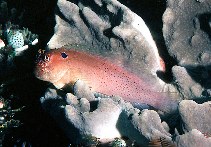 Cirripectes auritus
Изображение сделано Randall, J.E.
изображения | Изображение на Google
Изображение сделано Randall, J.E.
Классификация / Имена народные названия | синонимы | Catalog of Fishes(род, виды) | ITIS | CoL | WoRMS | Cloffa
> Blenniiformes (Blennies) > Blenniidae (Combtooth blennies) > Salariinae
Etymology: Cirripectes: Latin, cirrus = curl fringe + Greek, pektos, -e, -on = made of several parts solidly united (Ref. 45335); auritus: Name from Latin 'auritus', meaning 'eared', referring to the earlike nuchal flap on either side of the head.
Etymology: Cirripectes: Latin, cirrus = curl fringe + Greek, pektos, -e, -on = made of several parts solidly united (Ref. 45335); auritus: Name from Latin 'auritus', meaning 'eared', referring to the earlike nuchal flap on either side of the head.
Окружающая среда: среда / климатическая зона / пределы глубины / диапазон распространения экология
морской ассоциированный с рифами; пределы глубины 0 - 20 m (Ref. 630), usually 0 - 10 m (Ref. 529). Tropical; 20°N - 35°S
распространение Территории | регионы FAO | Экосистемы | места находок | карта точек | интродукции | Faunafri
Indo-West Pacific: Kenya to South Africa, then Similan Islands (Thailand), Philippines and the Line Islands.
Длина при первой зрелости / Размер / Вес / Возраст
Краткое описание определительные ключи | морфология | морфометрия
колючие лучи спинного плавника (общее число) : 12 - 13; членистые (мягкие) лучи спинного плавника (общее число) : 15 - 17; колючие лучи анального плавника: 2; членистые (мягкие) лучи анального плавника: 16 - 18; позвонки: 31 - 33. Diagnosis: Dorsal fin XII-XIII, 15-17 (usually XII,17), entire, only slightly or not at all incised above last spine, first spine equal to second; anal fin II, 15-16; pectoral rays 14; pelvic fin I, 4; caudal fin procurrent rays 10-13. Body depth at anal-fin origin 4.8-5.1 in SL. Vertebrae 10 + 21-23; vertebral centrum, last pleural ribs 11-12, last epipleural rib 17-19. Without scales and scalelike flaps. LL tubes 7-12, series ends below dorsal fin rays 5-13. Lower lip smooth mesially, plicate laterally. Upper lip crenulae 34-39. Gill rakers 21-25. Cirri, nuchal 22-34, supraorbital 2-7, nasal 4-6. Nuchal cirri minute, 5-8 independently distributed, in 2 greatly expanded flaps on each side of nape. Nuchal flaps black. Inner ring of iris yellow, outer ring reddish brown. Body coloration of adults variable (varies in different areas and may also vary between sexes); may be pale, brown, or mottled pale and brown background but always with tiny dark spots on posterior 1/2 to 3/4 of the body and with pale spots or streaks from orbit to upper lip. Similan and Fanning Islands females head mottled strongly with reddish-brown and pinkish-white spots and streaks, body with broad irregular brown bars; in Fanning Islands the pale areas in the head are all faint pink and interspaces on body are cream or light brown instead of faint pink as in those from Similan Islands. Males in Fanning I. are also mottled but in Indian Ocean only females are mottled. Philippines female has uniformly dark brown color. South African males with darker cirri than those from other localities. Meristic and morphometric patterns does not vary geographically. Body depth at anal fin origin 4.8-5.1 in SL (Ref. 529, 90102). Ophioblennius stage overall cream; mouth area without spots; cirri and nuchal flap pale; fins transluscent (in alcohol); with 2 canines on each dentary, posteriorly (Ref. 529). (Ref. 529).
Body shape (shape guide): elongated; Cross section: oval.
Body shape (shape guide): elongated; Cross section: oval.
Facultative air-breathing in the genus (Ref. 126274); Found on coral rocks, some on sandy bottom in water about 5 m deep or on irregular rocky bottom with sparse live coral and no sand (Ref. 630). Also in shallow protected reefs with rich coral and algae growth, usually found at depths less than about 10 m; occasionally deeper. Usually seen solitary (Ref. 48636). One specimen taken from 20 m in the Comoro Island. Oviparous. Eggs are demersal and adhesive (Ref. 205), and are attached to the substrate via a filamentous, adhesive pad or pedestal (Ref. 94114). Larvae are planktonic, often found in shallow, coastal waters (Ref. 94114).
Жизненный цикл и брачное поведение половая зрелость | размножение | нерест | икра | Плодовитость | личинки
Oviparous, distinct pairing (Ref. 205). Urogenital orifice of male genital papilla located basally between 2 widely separated slender filaments on a fleshy swelling behind anus; testes bulbous with length equal to width (Ref. 529).
Основная ссылка
Загрузите свои рекомендации | ссылки | координатор : Williams, Jeffrey T. | соавторы
Williams, J.T., 1988. Revision and phylogenetic relationships of the blenniid fish genus Cirripectes. Indo-Pac. Fish. (17):78 p. (Ref. 529)
Статус Красного Списка МСОП (Ref. 130435: Version 2025-2 (Global))
Не вызывающий беспокойства (LC) ; Date assessed: 24 March 2009
CITES
Not Evaluated
Угроза для людей
Harmless
Использование человеком
рыболовство: интереса не представляет
FAO - Publication: search | FishSource |
дополнительная информация
Трофическая экология
Пищевые предметы (добыча)
состав пищи
потребление пищи
Продовольственные пайки
хищники
Пищевые предметы (добыча)
состав пищи
потребление пищи
Продовольственные пайки
хищники
Динамика численности населения
Параметры роста
Макс. возраст / размер
Отношение длины к весу.
Отношение длины к длине.
Размерный состав
Преобразование массы
пополнение
численность
Параметры роста
Макс. возраст / размер
Отношение длины к весу.
Отношение длины к длине.
Размерный состав
Преобразование массы
пополнение
численность
Жизненный цикл
размножение
половая зрелость
Зрелость/Жиры относительно.
Плодовитость
нерест
Нерестовые скопления
икра
Развитие икры
личинки
динамика численности личинок
размножение
половая зрелость
Зрелость/Жиры относительно.
Плодовитость
нерест
Нерестовые скопления
икра
Развитие икры
личинки
динамика численности личинок
Анатомия
жаберная область
Мозг
Отолит
жаберная область
Мозг
Отолит
Физиология
Состав тела
Питательные вещества
Потребление кислорода
Тип плавания
Скорость плавания
Зрительные пигменты
Звук рыбы
Болезни и паразиты
Токсичность (LC50s)
Состав тела
Питательные вещества
Потребление кислорода
Тип плавания
Скорость плавания
Зрительные пигменты
Звук рыбы
Болезни и паразиты
Токсичность (LC50s)
Связанные с человеком
Системы аквакультуры
особенности рыбоводства
степень растяжения
Случаи заболевания сигуатерой
Марки, монеты и прочее.
Системы аквакультуры
особенности рыбоводства
степень растяжения
Случаи заболевания сигуатерой
Марки, монеты и прочее.
инструменты
Органическая викторина | Электронная книга | полевой определитель | определительные ключи | Длина-Частота | онтогенез | карта точек |
Catch-MSY |
Специальные отчеты
Проверить содержание в аквариумах | Проверить опубликованные видовые данные | Проверить опубликованные данные по аквакультуре
Скачать в формате XML
ресурсы в Интернет
AFORO (otoliths) | Aquatic Commons | BHL | Cloffa | Websites from users | Проверить FishWatcher | CISTI | Catalog of Fishes: род, виды | DiscoverLife | ECOTOX | FAO - Publication: search | Faunafri | Fishipedia | Fishtrace | GloBI | Google Books | Google Scholar | Google | IGFA World Record | национальные базы данных | OneZoom | Open Tree of Life | Otolith Atlas of Taiwan Fishes | PubMed | Reef Life Survey | Socotra Atlas | TreeBase | Tree of Life | Wikipedia: Вперёд, поиск | World Records Freshwater Fishing | Zoobank | Зоологическая летопись
Оценки, основанные на моделях
Предпочтительная температура (ссылка 123201): 25.4 - 29.3, mean 28.5 °C (based on 2513 cells).
Индекс филогенетического разнообразия (ссылка 82804): PD50 = 0.5000 [Uniqueness, from 0.5 = low to 2.0 = high].
Bayesian length-weight: a=0.00776 (0.00354 - 0.01702), b=3.00 (2.81 - 3.19), in cm total length, based on LWR estimates for this (Sub)family-body shape (Ref. 93245).
Трофический уровень (ссылка 69278): 2.0 ±0.00 se; based on food items.
устойчивость к внешним воздействиям (ссылка 120179): высокий, минимальное время удвоения популяции до 15 месяцев (Preliminary K or Fecundity.).
Питательные вещества (Ref. 124155): Calcium = 189 [90, 334] mg/100g; Iron = 0.92 [0.52, 1.66] mg/100g; Protein = 17.8 [16.5, 18.9] %; Omega3 = 0.0885 [, ] g/100g; Selenium = 23.9 [10.8, 56.6] μg/100g; VitaminA = 130 [31, 544] μg/100g; Zinc = 2.93 [1.88, 4.33] mg/100g (wet weight);