



Lägg till din observation i Fish Watcher
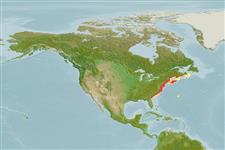
| Native range | All suitable habitat | Point map | Year 2050 |
|
| This map was computer-generated and has not yet been reviewed. |
| Tautoga onitis AquaMaps Data sources: GBIF OBIS |
Ladda upp din foton och Videor
Bilder | Google image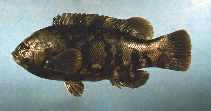 Tautoga onitis
Bild av Flescher, D.
Bilder | Google image
Bild av Flescher, D.
Klassificering / Namn Populärnamn | synonymer | Catalog of Fishes(Släkte, Arter) | ITIS | CoL | WoRMS | Cloffa
> Eupercaria/misc (Various families in series Eupercaria) > Labridae (Wrasses) > Labrinae
Etymology: Tautoga: Plural of the word "taut", an Indian Brazil name translated by Roger William from f the Narragansett, "tautauog" = sheepshead.
More on author: Linnaeus.
Etymology: Tautoga: Plural of the word "taut", an Indian Brazil name translated by Roger William from f the Narragansett, "tautauog" = sheepshead.
More on author: Linnaeus.
Miljö: miljö / Klimatzon / djupintervall / distributionsområde Ekologi
marina; brackvatten revassocierade; djupintervall 1 - 75 m. Subtropical; 46°N - 31°N, 81°W - 58°W
Utbredning Territorier | FAO områden | Ekosystem | Förekomster | Prickkarta | Utplanteringar | Faunafri
Western Atlantic: slightly east of Halifax in Nova Scotia, Canada to South Carolina in USA; most abundant between Cape Cod and Delaware Bay.
Längd vid första mognad / Storlek / Vikt / Ålder
Könsmognad: Lm 23.6, range 18 - 26.5 cm
Max length : 91.0 cm TL hane/ej könsbestämd; (Ref. 7251); publicerad maxvikt: 11.3 kg (Ref. 40637); rapporterad maxålder: 34 år (Ref. 6486)
Max length : 91.0 cm TL hane/ej könsbestämd; (Ref. 7251); publicerad maxvikt: 11.3 kg (Ref. 40637); rapporterad maxålder: 34 år (Ref. 6486)
Kort beskrivning Bestämningsnycklar | Morfologi | Morfometri
Taggstrålar i ryggfenan (totalt) : 16 - 17; Mjukstrålar i ryggfenan (totalt) : 10; Taggstrålar i analfenan: 3; Mjukstrålar i analfenan: 7 - 8. Distinguished from Tautogolabrus adspersus which occurs in the same area and further north, by its steep, rounded dorsal head profile; stouter body; scaled lower gill cover; and the more backward location of the pelvic fins.
Body shape (shape guide): fusiform / normal; Cross section: compressed.
Body shape (shape guide): fusiform / normal; Cross section: compressed.
Found close to shore on hard-bottom habitats, occasionally entering brackish water. Adult male territorial and active during the day to feed and rests in crevices at night. Prefers temperatures above 10°C. Spawning was noted in June-July in Canadian waters, but appears more protracted (April-July) in coastal waters of Virginia, USA. Feeds mainly on mussels, gastropods, other mollusks and crustaceans. This species has gained popularity as a prized food and sport fish (Ref. 6486, 4926, 41297). Investigation on the diel and seasonal activity patterns of the adult tautog in its southern range were conducted using ultrasonic telemetry (Ref. 41297).
Livscykel och parningsbeteende Könsmognad | Reproduktion | Lek | Ägg | Fekunditet | Larver
Spawns in groups or in pairs. Pairing occurs between females and size-dominant males exhibiting strong territoriality and performing a protracted courtship (Ref. 6488). Gonochorism is confirmed for this species (Ref. 103751).
Huvudreferens
Ladda upp dina referenser | referenser | Koordinator : Westneat, Mark | Medarbetare
Leim, A.H. and W.B. Scott, 1966. Fishes of the Atlantic coast of Canada. Bull. Fish. Res. Board Can. (155):485 p. (Ref. 4926)
Status på IUCN:s rödlista (Ref. 130435: Version 2025-2 (Global))
Sårbar (VU) (A2bd); Date assessed: 12 July 2008
CITES
Not Evaluated
Hot mot människor
Harmless
Mänskliga användningsområden
Fiskeri: mindre kommeriell; sportfisk: ja; Akvarium: Offentliga akvarier
FAO - fiskeri: landningar; Publication: search | FishSource | Havet omkring oss
Ytterligare information
Populationsdynamik
Tillväxtparametrar
Max. åldrar / storlekar
Längd-vikt rel.
Längd-längd rel.
Längd-frekvenser
Massakonvertering
Rekrytering
Abundans
Tillväxtparametrar
Max. åldrar / storlekar
Längd-vikt rel.
Längd-längd rel.
Längd-frekvenser
Massakonvertering
Rekrytering
Abundans
Livscykel
Reproduktion
Könsmognad
Mognad/Gills rel.
Fekunditet
Lek
Lekande aggregat
Ägg
Utveckling av ägg
Larver
Larvdynamik
Reproduktion
Könsmognad
Mognad/Gills rel.
Fekunditet
Lek
Lekande aggregat
Ägg
Utveckling av ägg
Larver
Larvdynamik
Fysiologi
Kroppssammansättning
Näringsämnen
Syreförbrukning
Typ av simning
Simhastighet
Visuella pigment
Ljud från fisk
Sjukdomar & Parasiter
Toxicitet (LC50)
Kroppssammansättning
Näringsämnen
Syreförbrukning
Typ av simning
Simhastighet
Visuella pigment
Ljud från fisk
Sjukdomar & Parasiter
Toxicitet (LC50)
Människorelaterad
Vattenbrukssystem
Vattenbruksprofiler
Avelslinjer
Ciguatera-fall
Frimärken, mynt, diverse.
Vattenbrukssystem
Vattenbruksprofiler
Avelslinjer
Ciguatera-fall
Frimärken, mynt, diverse.
Verktyg
Särskilda rapporter
Kontrollera för underhåll av akvarium | Kontrollera om det finns faktablad om arter | Kontrollera om det finns faktablad om vattenbruk
Ladda ner XML
Internet-källor
AFORO (otoliths) | Alien/Invasive Species database | Aquatic Commons | BHL | Cloffa | Websites from users | Check FishWatcher | CISTI | Catalog of Fishes: Släkte, Arter | DiscoverLife | ECOTOX | FAO - fiskeri: landningar; Publication: search | Faunafri | Fishipedia | Fishtrace | GloBI | Google Books | Google Scholar | Google | IGFA World Record | OneZoom | Open Tree of Life | Otolith Atlas of Taiwan Fishes | Offentliga akvarier | PubMed | Reef Life Survey | Socotra Atlas | TreeBase | Tree of Life | Wikipedia: Go, sök | World Records Freshwater Fishing | Zoologiskt register
Uppskattningar baserade på modeller
Önskad temperatur (Ref. 123201): 5.3 - 22.8, mean 10.9 °C (based on 96 cells).
Index för fylogenetisk mångfald (Ref. 82804): PD50 = 1.0000 [Uniqueness, from 0.5 = low to 2.0 = high].
Bayesian length-weight: a=0.01259 (0.00824 - 0.01922), b=3.05 (2.92 - 3.18), in cm total length, based on LWR estimates for this species & (Sub)family-body (Ref. 93245).
Trofisk nivå (Ref. 69278): 3.3 ±0.47 se; based on food items.
Resiliens (Ref. 120179): Låg, lägsta populationsfördubblingstid 4,5-14 år (K=0.09; tm=2-3; tmax=34).
Näringsämnen (Ref. 124155): Calcium = 16.1 [7.1, 31.7] mg/100g; Iron = 0.447 [0.241, 0.886] mg/100g; Protein = 19.5 [16.6, 21.7] %; Omega3 = 0.193 [0.107, 0.343] g/100g; Selenium = 18.8 [9.2, 37.9] μg/100g; VitaminA = 39.3 [11.0, 166.7] μg/100g; Zinc = 0.912 [0.612, 1.593] mg/100g (wet weight);