



Macrochirichthys macrochirus (Valenciennes, 1844)
Long pectoral-fin minnow
Hochladen Photos und videos
Bilder | Google Bild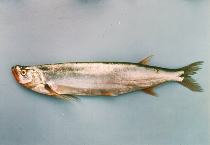 Macrochirichthys macrochirus
Photo von Baird, I.G.
Bilder | Google Bild
Photo von Baird, I.G.
Klassifizierung / Names Namen | Synonyme | Catalog of Fishes(Gattung, Arten) | ITIS | CoL | WoRMS | Cloffa
> Cypriniformes (Carps) > Xenocyprididae (East Asian minnows)
Etymology: Macrochirichthys: Greek, makros = great + Greek, cheir = hand + Greek, ichthys = fish (Ref. 45335).
More on author: Valenciennes.
Etymology: Macrochirichthys: Greek, makros = great + Greek, cheir = hand + Greek, ichthys = fish (Ref. 45335).
More on author: Valenciennes.
Umwelt: Milieu / Klimazone / Tiefenbereich / Verbreitungsgebiet Ökologie
; süßwasser benthopelagisch; potamodrom (Ref. 138296). Tropical
Verbreitung Territorien | FAO Gebiete | Ökosysteme | Vorkommen | Punkt Karte | Einführungen | Faunafri
Asia: Thailand to Viet Nam and Indonesia (Ref. 7050). Known from the Mekong and Chao Phraya basins (Ref. 26580).
Größe / Gewicht / Alter
Geschlechtsreife: Lm ? range ? - ? cm
Max length : 100.0 cm TL Männchen/unbestimmt; (Ref. 7050); common length : 35.0 cm SL Männchen/unbestimmt; (Ref. 2686)
Max length : 100.0 cm TL Männchen/unbestimmt; (Ref. 7050); common length : 35.0 cm SL Männchen/unbestimmt; (Ref. 2686)
Kurzbeschreibung Bestimmungsschlüssel | Morphologie | Morphometrie
Rückenflossenweichstrahlen (insgesamt) : 10; Afterflossenweichstrahlen: 25 - 27. Head upturned; no barbels; belly with sharp keel from throat to anus (Ref. 43281). Body strongly compressed; dorsal profile flat except concave nape. Mouth directed upward. Pectoral fins elongated. Base of caudal fin with black blotch (Ref. 4792). Lower jaw protruded, tip of it hooked and inlaid into gap of upper jaw; scales minute and irregularly arranged (Ref. 45563).
Body shape (shape guide): elongated.
Body shape (shape guide): elongated.
Found in large rivers and lakes at medium to shallow depths. Juveniles feed on insects while adults on fish (Ref. 12693). Move towards the flooded forest when the water is high and returns to the river as soon as the water level starts to subside (Ref. 12693). Good flesh but fairly soft and with numerous bones. In Laos, it is usually grilled, simmered with padek and made into Ponne pa. Usually marketed fresh and probably exported to Thailand (Ref. 12693). Widely distributed but greatly reduced in numbers probably throughout its range. Extremely sensitive to gillnetting and perhaps also to pollution (Ref. 12369).
Lebenszyklus und Paarungsverhalten Geschlechtsreife | Fortpflanzung | Ablaichen | Eier | Fruchtbarkeit | Larven
Hauptreferenz
Laden Sie Ihre Referenzen hoch | Referenzen | Koordinator | Partner
Rainboth, W.J., 1996. Fishes of the Cambodian Mekong. FAO species identification field guide for fishery purposes. FAO, Rome, 265 p. (Ref. 12693)
IUCN Rote Liste Status (Ref. 130435: Version 2025-2 (Global))
nicht bedroht (LC) ; Date assessed: 31 January 2019
CITES
Not Evaluated
Bedrohung für Menschen
Harmless
Nutzung durch Menschen
Fischereien: kommerziell
FAO - Fischereien: landungen; Publication: search | FishSource |
Mehr Information
Trophische Ökologie
Lebensmittel (Beutetiere)
Nahrungszusammensetzung
Nahrungsaufnahme
Lebensmittelrationen
Räuber
Lebensmittel (Beutetiere)
Nahrungszusammensetzung
Nahrungsaufnahme
Lebensmittelrationen
Räuber
Populationsdynamik
Wachstumsparameter
Max. Alter/Größen
Länge-Gewicht-Rel.
Länge-Länge-Verhältnis.
Längenhäufigkeiten
Massenkonvertierung
Rekrutierung
Dichte
Wachstumsparameter
Max. Alter/Größen
Länge-Gewicht-Rel.
Länge-Länge-Verhältnis.
Längenhäufigkeiten
Massenkonvertierung
Rekrutierung
Dichte
Lebenszyklus
Fortpflanzung
Geschlechtsreife
Reifung/Kiemen rel.
Fruchtbarkeit
Ablaichen
Laichaggregationen
Eier
Eientwicklung
Larven
Larven Pop.Dyn.
Fortpflanzung
Geschlechtsreife
Reifung/Kiemen rel.
Fruchtbarkeit
Ablaichen
Laichaggregationen
Eier
Eientwicklung
Larven
Larven Pop.Dyn.
Anatomie
Kiemenoberfläche
Gehirn
Otolith
Kiemenoberfläche
Gehirn
Otolith
Physiologie
Körperliche Zusammensetzung
Nährstoffe
Sauerstoffverbrauch
Schwimmart
Schwimmgeschwindigkeit
Visuelle Pigmente
Fischgeräusche
Krankheiten und Parasiten
Toxizität (LC50s)
Körperliche Zusammensetzung
Nährstoffe
Sauerstoffverbrauch
Schwimmart
Schwimmgeschwindigkeit
Visuelle Pigmente
Fischgeräusche
Krankheiten und Parasiten
Toxizität (LC50s)
Genetik
Genom
Genetik
Heterozygotie
Vererbbarkeit
Genetische Vielfalt
Genom
Genetik
Heterozygotie
Vererbbarkeit
Genetische Vielfalt
Menschenbezogen
Aquakultur-Systeme
Aquakultur Profile
Zuchtlinien
Ciguatera-Fälle
Briefmarken, Münzen, Verschiedenes.
Aquakultur-Systeme
Aquakultur Profile
Zuchtlinien
Ciguatera-Fälle
Briefmarken, Münzen, Verschiedenes.
Tools
Zusatzinformationen
Download XML
Zusammenfassung | Punktdaten | Namen | Photos
Internet Quellen
AFORO (otoliths) | Aquatic Commons | BHL | Cloffa | Websites from users | FishWatcher Einträge suchen | CISTI | Catalog of Fishes: Gattung, Arten | DiscoverLife | ECOTOX | FAO - Fischereien: landungen; Publication: search | Faunafri | Fishipedia | Fishtrace | GloBI | Google Books | Google Scholar | Google | IGFA World Record | OneZoom | Open Tree of Life | Otolith Atlas of Taiwan Fishes | PubMed | Reef Life Survey | Socotra Atlas | TreeBase | Tree of Life | Wikipedia: Gehe zu, Suchen | World Records Freshwater Fishing | Zoologischer Rekord
Schätzungen auf der Grundlage von Modellen
Phylogenetischer Diversitätsindex (Ref. 82804): PD50 = 1.0000 [Uniqueness, from 0.5 = low to 2.0 = high].
Bayesian length-weight: a=0.00631 (0.00298 - 0.01335), b=3.07 (2.90 - 3.24), in cm total length, based on LWR estimates for this (Sub)family-body shape (Ref. 93245).
Trophische Ebene (Ref. 69278): 3.7 ±0.57 se; based on food items.
Widerstandsfähigkeit (Ref. 120179): sehr niedrig, Verdopplung der Population dauert mehr als 14 Jahre. (Preliminary K or Fecundity.).
Nährstoffe (Ref. 124155): Calcium = 92.2 [52.3, 163.9] mg/100g; Iron = 1.23 [0.76, 1.98] mg/100g; Protein = 17.1 [16.1, 18.1] %; Omega3 = 0.271 [0.118, 0.610] g/100g; Selenium = 91.9 [35.8, 208.3] μg/100g; VitaminA = 78.1 [28.3, 230.9] μg/100g; Zinc = 1.34 [0.94, 1.89] mg/100g (wet weight);