This website uses cookies to enhance your browsing experience and ensure the functionality of our site. For more detailed information about the types of cookies we use and how we protect your privacy, please visit our Privacy Information page.
×
Cookie Settings
This website uses different types of cookies to enhance your experience. Please select your preferences below:
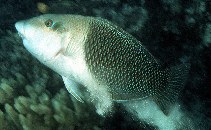
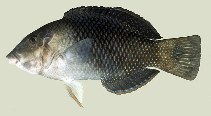
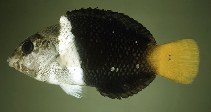
Épines dorsales (Total) : 9; Rayons mous dorsaux (Total) : 10 - 11; Épines anales: 3; Rayons mous anaux: 11. This species is distinguished by the following characters: gill rakers 26-29; small juveniles dark brown, green on snout and interorbital, with a slightly oblique white bar from front of dorsal fin to abdomen, and 2 narrow pale yellowish bars below soft portion of dorsal fin that fade ventrally; larger juveniles have a white bar from origin of dorsal fin, passing beneath pectoral fin onto abdomen; head and body anterior to bar greyish green, posterior to bar black; posterior caudal peduncle and caudal fin yellow, often with 1 or 2 small black spots centrally near base: small females with body posterior to a curving demarcation between origins of dorsal and anal fins blackish with a narrow dark greenish bar on each scale, grading to yellow with blue-green spots posteriorly on caudal peduncle and fin; large females dark green posterior to oblique demarcation on body, the scales rimmed in black, with a vertical green line or spot on each scale; head and anterior body light green dorsally, pale blue-green ventrally, have irregular bands on snout and above eye, and a large complex marking behind eye; body of males posterior to demarcation dark green, each scale with narrow pale blue-green and black posterior margin; head green dorsally with irregular green to blue-green bands, including a blue ring around eye; cheek and operculum pinkish white with irregular light blue lines and spots, except for a large yellowish green blotch centrally on cheek without markings; lips and ventral part of head mainly pale blue; chest and abdomen pinkish white with a light blue spot or arc on scales (Ref. 93095). Body shape (shape guide): fusiform / normal; Cross section: compressed.
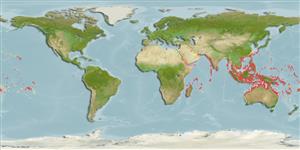
Found in subtidal reef flats and lagoon and seaward reefs. Juveniles occur inshore, found among branching corals while adults found in areas of mixed sand, rubble, and coral (Ref. 9710). Large adults in deeper water (Ref. 48636). Maximum length beyond 45 cm TL is unlikely, with largest measured individual at 37 cm TL (Ref, Feeds mainly on small invertebrates, especially crustaceans, polychaete worms, mollusks and brittle stars (Ref. 9823). Diet changing from primarily demersal planktonic crustaceans to hard-shelled invertebrates with growth (Ref. 37816). Minimum depth reported taken from Ref. 128797.
Cycle de vie et comportement reproducteur Maturité | Reproduction | Frai | Œufs | Fécondité | Larves
Oviparous, with distinct pairing during breeding (Ref. 205).
Cycle de vie Reproduction Maturité Maturité/épines rel. Fécondité Frai Agrégats de frai Œufs Développement de l'œuf Larves Dynamique des populations larvaires
Température préférée (Réf. 123201): 24.6 - 29, mean 27.8 °C (based on 1006 cells).
Indice de diversité phylogénétique (Réf. 82804): PD50 = 0.6250 [Uniqueness, from 0.5 = low to 2.0 = high].
Bayesian length-weight: a=0.01479 (0.00946 - 0.02312), b=3.02 (2.89 - 3.15), in cm total length, based on LWR estimates for this species & (Sub)family-body (Ref. 93245).
Niveau trophique (Réf. 69278): 3.6 ±0.45 se; based on food items.
Résilience (Réf. 120179): Milieu, temps minimum de doublement de population : 1,4 à 4,4 années (Preliminary K or Fecundity.).
Vulnérabilité de la pêche (Ref. 59153): Low to moderate vulnerability (30 of 100). 🛈