



Ellochelon vaigiensis (Quoy & Gaimard, 1825)
Squaretail mullet
Beobachtung melden im Fish Watcher
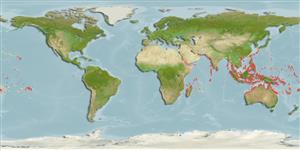
| Native range | All suitable habitat | Point map | Year 2050 |
|
| This map was computer-generated and has not yet been reviewed. |
| Ellochelon vaigiensis AquaMaps Data sources: GBIF OBIS |
Hochladen Photos und videos
Bilder | videos | Google Bild Ellochelon vaigiensis
Photo von Dubosc, J.
Bilder | videos | Google Bild
Photo von Dubosc, J.
Klassifizierung / Names Namen | Synonyme | Catalog of Fishes(Gattung, Arten) | ITIS | CoL | WoRMS | Cloffa
Taxonomic Remarks
Genetic data indicate that Ellochelon vaigiensis is a complex of species (Ref. 114224). At least 3 species have been recognized (Refs. 114224, 123263, work in progress) and are being described, with probable parapatric distributions (Durand, pers. comm., Nov. 2020).
Umwelt: Milieu / Klimazone / Tiefenbereich / Verbreitungsgebiet Ökologie
seewasser; süßwasser; brackwasser riff-verbunden; katadrom (Ref. 46888); tiefenbereich 0 - 5 m (Ref. 89972). Tropical; 32°N - 24°S, 30°E - 141°W
Verbreitung Territorien | FAO Gebiete | Ökosysteme | Vorkommen | Punkt Karte | Einführungen | Faunafri
Indo-Pacific: Red Sea and from East Africa to the Tuamoto Islands, north to southern Japan, south to southern Great Barrier Reef and New Caledonia (Ref. 9812).
Größe / Gewicht / Alter
Geschlechtsreife: Lm ? range ? - ? cm
Max length : 63.0 cm TL Männchen/unbestimmt; (Ref. 9710); common length : 35.0 cm TL Männchen/unbestimmt; (Ref. 9812)
Max length : 63.0 cm TL Männchen/unbestimmt; (Ref. 9710); common length : 35.0 cm TL Männchen/unbestimmt; (Ref. 9812)
Kurzbeschreibung Bestimmungsschlüssel | Morphologie | Morphometrie
Rückenflossenstacheln (insgesamt) : 5; Rückenflossenweichstrahlen (insgesamt) : 8 - 10; Afterflossenstacheln: 3; Afterflossenweichstrahlen: 7 - 9. Diagnosis: This species is distinguished by the following characters: robust body; usually with 16 pectoral-fin rays; 25-29 longitudinal scales; 16 circumpeduncular scales; weakly ctenoid scales; adults with longer snout than eye diameter, shorter in juvenile; poorly developed adipose eyelid, forming narrow rim around eye; weak notch on anteroventral edge of preorbital; truncate caudal fin; colour olive-brown dorsally, flanks and belly silvery to whitish; about 6 brownish stripes on flank formed by longitudinal marks on scales; fins yellowish white with dusky margins except caudal fin yellow and pectoral black dorsally and yellow ventrally (completely black in young); no axillary scale visible in the pectoral fins (Ref. 9812, 90102).
Body shape (shape guide): fusiform / normal; Cross section: oval.
Body shape (shape guide): fusiform / normal; Cross section: oval.
Found in lagoons, reef flats, estuaries, and coastal creeks, in shallow coastal areas and protected sandy shores (Ref. 40488). Usually within tidal influence, but may enter fresh water, ascending 10 km into rivers (Ref. 40488). Forms large schools, frequently in mangrove areas (Ref. 2334). Juveniles may be found in rice fields and mangroves and may be used as bait fish (Ref. 9812). Oviparous, eggs are pelagic and non-adhesive (Ref. 205). Feeds on phytoplankton, small algae and detritus organisms (Ref. 89972). Caught in cast nets, stake
nets, beach seines, and gill nets; marketed fresh and salted; boiled (Thailand), canned or frozen (Australia). Roe also marketed salted and juveniles used as bait fish (Ref. 9812)..
Lebenszyklus und Paarungsverhalten Geschlechtsreife | Fortpflanzung | Ablaichen | Eier | Fruchtbarkeit | Larven
Hauptreferenz
Laden Sie Ihre Referenzen hoch | Referenzen | Koordinator : Harrison, Ian | Partner
Myers, R.F., 1991. Micronesian reef fishes. Second Ed. Coral Graphics, Barrigada, Guam. 298 p. (Ref. 1602)
IUCN Rote Liste Status (Ref. 130435: Version 2025-2 (Global))
nicht bedroht (LC) ; Date assessed: 02 July 2016
CITES
Not Evaluated
Bedrohung für Menschen
Reports of ciguatera poisoning (Ref. 130160)
Nutzung durch Menschen
Fischereien: kommerziell; Aquakultur: kommerziell; Aquarium: Kommerziell; Köder: occasionally
FAO - Aquakultur-Systeme: produktion; ; Publication: search | FishSource | Das Meer um uns herum
Mehr Information
Trophische Ökologie
Lebensmittel (Beutetiere)
Nahrungszusammensetzung
Nahrungsaufnahme
Lebensmittelrationen
Räuber
Lebensmittel (Beutetiere)
Nahrungszusammensetzung
Nahrungsaufnahme
Lebensmittelrationen
Räuber
Populationsdynamik
Wachstumsparameter
Max. Alter/Größen
Länge-Gewicht-Rel.
Länge-Länge-Verhältnis.
Längenhäufigkeiten
Massenkonvertierung
Rekrutierung
Dichte
Wachstumsparameter
Max. Alter/Größen
Länge-Gewicht-Rel.
Länge-Länge-Verhältnis.
Längenhäufigkeiten
Massenkonvertierung
Rekrutierung
Dichte
Lebenszyklus
Fortpflanzung
Geschlechtsreife
Reifung/Kiemen rel.
Fruchtbarkeit
Ablaichen
Laichaggregationen
Eier
Eientwicklung
Larven
Larven Pop.Dyn.
Fortpflanzung
Geschlechtsreife
Reifung/Kiemen rel.
Fruchtbarkeit
Ablaichen
Laichaggregationen
Eier
Eientwicklung
Larven
Larven Pop.Dyn.
Physiologie
Körperliche Zusammensetzung
Nährstoffe
Sauerstoffverbrauch
Schwimmart
Schwimmgeschwindigkeit
Visuelle Pigmente
Fischgeräusche
Krankheiten und Parasiten
Toxizität (LC50s)
Körperliche Zusammensetzung
Nährstoffe
Sauerstoffverbrauch
Schwimmart
Schwimmgeschwindigkeit
Visuelle Pigmente
Fischgeräusche
Krankheiten und Parasiten
Toxizität (LC50s)
Genetik
Genom
Genetik
Heterozygotie
Vererbbarkeit
Genetische Vielfalt
Genom
Genetik
Heterozygotie
Vererbbarkeit
Genetische Vielfalt
Menschenbezogen
Aquakultur-Systeme
Aquakultur Profile
Zuchtlinien
Ciguatera-Fälle
Briefmarken, Münzen, Verschiedenes.
Aquakultur-Systeme
Aquakultur Profile
Zuchtlinien
Ciguatera-Fälle
Briefmarken, Münzen, Verschiedenes.
Tools
E-Book | Feldführer | Bestimmungsschlüssel | Längenhäufigkeits Tool | Lebensdaten Tool | Punkt Karte |
Catch-MSY |
Zusatzinformationen
Download XML
Zusammenfassung | Punktdaten | Namen | Photos
Internet Quellen
AFORO (otoliths) | Aquatic Commons | BHL | Cloffa | Websites from users | FishWatcher Einträge suchen | CISTI | Catalog of Fishes: Gattung, Arten | DiscoverLife | ECOTOX | FAO - Aquakultur-Systeme: produktion; ; Publication: search | Faunafri | Fishipedia | Fishtrace | GloBI | Google Books | Google Scholar | Google | IGFA World Record | OneZoom | Open Tree of Life | Otolith Atlas of Taiwan Fishes | PubMed | Reef Life Survey | Socotra Atlas | TreeBase | Tree of Life | Wikipedia: Gehe zu, Suchen | World Records Freshwater Fishing | Zoologischer Rekord
Schätzungen auf der Grundlage von Modellen
Bevorzugte Temperatur (Ref. 123201): 25.3 - 29.3, mean 28.5 °C (based on 3039 cells).
Phylogenetischer Diversitätsindex (Ref. 82804): PD50 = 1.0000 [Uniqueness, from 0.5 = low to 2.0 = high].
Bayesian length-weight: a=0.01175 (0.00749 - 0.01843), b=3.02 (2.89 - 3.15), in cm total length, based on LWR estimates for this species & (Sub)family-body (Ref. 93245).
Trophische Ebene (Ref. 69278): 2.2 ±0.1 se; based on diet studies.
Widerstandsfähigkeit (Ref. 120179): mittel, Verdopplung der Population dauert 1,4 - 4,4 Jahre. (Preliminary K or Fecundity.).
Nährstoffe (Ref. 124155): Calcium = 47.6 [18.7, 154.6] mg/100g; Iron = 0.591 [0.262, 1.397] mg/100g; Protein = 19 [17, 21] %; Omega3 = 0.147 [0.070, 0.313] g/100g; Selenium = 24.3 [12.2, 55.8] μg/100g; VitaminA = 54.7 [12.3, 239.4] μg/100g; Zinc = 1.78 [1.12, 2.73] mg/100g (wet weight);