This website uses cookies to enhance your browsing experience and ensure the functionality of our site. For more detailed information about the types of cookies we use and how we protect your privacy, please visit our Privacy Information page.
×
Cookie Settings
This website uses different types of cookies to enhance your experience. Please select your preferences below:
> Ovalentaria/misc (Various families in series Ovalentaria) > Pomacentridae (Damselfishes) > Chrominae
Etymology: pacifica:Named for its native range, in the Pacific Ocean; noun in apposition.
Environnement : milieu / zone climatique / profondeur / gamme de distribution Écologie
marin récifal; non migrateur; profondeur 5 - 56 m (Ref. 122787). Tropical; 31°N - 30°S
Pacific Ocean: Hawaiian Islands, Johnston Atoll, Line Islands, Pitcairn Island, Oeno Atoll, Gambier Islands, Tuamotu Archipelago, Society Islands, Austral Islands, Rapa, Cook Islands, Phoenix Islands, Fiji, Tonga, New Caledonia, Loyalty Islands, Chesterfield Islands, Vanuatu, Coral Sea islands and reefs, Marshall Islands, Chuuk, Pohnpei, Yap, Wake Island, Mariana Islands, and at the Ogasawara Islands and Bonin Islands of Japan.
Taille / Poids / Âge
Maturité: Lm? range ? - ? cm Max length : 7.6 cm SL mâle / non sexé; (Ref. 122787)
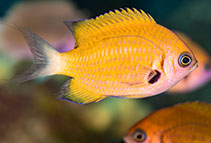
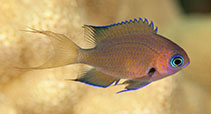
Épines dorsales (Total) : 12; Rayons mous dorsaux (Total) : 12 - 14; Épines anales: 2; Rayons mous anaux: 12 - 14; Vertèbres: 26. This species is distinguished by the following set of characters: D XII,12-14 (usually XII,13); A II,12-14 (usually II,13); pectoral-fin rays 16-18 (usually 17); spiniform caudal-fin rays 2; tubed lateral-line scales 14-17 (usually 15-16); total gill rakers on first branchial arch 27-32; body depth 1.8-2.0 (mean 1.9) in SL. Colouration: in life overall yellowish brown, typically with lateral greyish to purplish stripes along scale rows; the dorsal and anal fins are brownish with dark-brown triangular marking posteriorly and caudal fin yellowish; pectoral fin with a prominent round, blackish spot covering the entire base and axil (Ref. 122787). Cross section: compressed.
Benthopelagic (Ref. 58302). Feeds on planktons (Ref. 89972). Diurnal species (Ref. 54980; 113699). Oviparous, distinct pairing during breeding (Ref. 205). Eggs are demersal and adhere to the substrate (Ref. 205). Males guard and aerate the eggs (Ref. 205).
Cycle de vie et comportement reproducteur Maturité | Reproduction | Frai | Œufs | Fécondité | Larves
Oviparous, distinct pairing during breeding (Ref. 205). Eggs are demersal and adhere to the substrate (Ref. 205). Males guard and aerate the eggs (Ref. 205).
Allen, G.R. and M.V. Erdmann, 2020. Chromis pacifica, a new Pacific Ocean damselfish distinct from Indian Ocean Chromis agilis (Teleostei: Pomacentridae). J. Ocean Sci. Found. 35:102-117. (Ref. 122787)
Statut dans la liste rouge de l'IUCN (Ref. 130435: Version 2025-2 (Global))
Dynamique des populations Paramètres de croissance Âges / tailles maximales Longueur-poids rel. Rel. longueur-longueur. Fréquences de longueurs Conversion de masse Recrutement Abondance
Cycle de vie Reproduction Maturité Maturité/épines rel. Fécondité Frai Agrégats de frai Œufs Développement de l'œuf Larves Dynamique des populations larvaires
Physiologie Composition corporelle Nutriments Consommation d'oxygène Type de natation Vitesse de nage Pigments visuels Son de poisson Maladies et parasites Toxicité (CL50)
Température préférée (Réf. 123201): 24.6 - 28.8, mean 27.4 °C (based on 376 cells).
Indice de diversité phylogénétique (Réf. 82804): PD50 = 0.5000 [Uniqueness, from 0.5 = low to 2.0 = high].
Bayesian length-weight: a=0.02089 (0.00931 - 0.04686), b=2.98 (2.79 - 3.17), in cm total length, based on LWR estimates for this (Sub)family-body shape (Ref. 93245).
Niveau trophique (Réf. 69278): 3.0 ±0.24 se; based on food items.
Résilience (Réf. 120179): Haut, temps minimum de doublement de population inférieur à 15 mois (Preliminary K or Fecundity.).
Vulnérabilité de la pêche (Ref. 59153): Low vulnerability (10 of 100). 🛈