This website uses cookies to enhance your browsing experience and ensure the functionality of our site. For more detailed information about the types of cookies we use and how we protect your privacy, please visit our Privacy Information page.
×
Cookie Settings
This website uses different types of cookies to enhance your experience. Please select your preferences below:
> Ovalentaria/misc (Various families in series Ovalentaria) > Pomacentridae (Damselfishes) > Glyphisodontinae
Etymology: Abudefduf:Arabic, abu = father; this fish is the leader of the reef against other species (Ref. 45335). More on author: Lacepède.
Umwelt: Milieu / Klimazone / Tiefenbereich / Verbreitungsgebiet Ökologie
Indo-Pacific: Red Sea to Pinda, Mozambique (Ref. 4391) and the Tuamoto Islands, north to southern Japan, south to Lord Howe and Rapa islands. Not recorded from the Hawaiian Islands.
Größe / Gewicht / Alter
Geschlechtsreife: Lm? range ? - ? cm Max length : 19.0 cm TL Männchen/unbestimmt; (Ref. 90102)
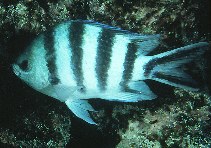
Rückenflossenstacheln (insgesamt) : 13; Rückenflossenweichstrahlen (insgesamt) : 12 - 16; Afterflossenstacheln: 2; Afterflossenweichstrahlen: 12 - 14. Body shape (shape guide): short and / or deep; Cross section: compressed.
Adults inhabit inshore and offshore coral or rocky reefs. Also in shallow coastal reef flats or crests, usually where lots of tall soft corals or hydroid colonies are present (Ref. 48636). Often found in groups feeding at midwater or tending nests among rocks and coral ledges (Ref. 90102). Feed on zooplankton and algae and aggregates high in the water column (Ref. 9710). Oviparous, distinct pairing during breeding (Ref. 205). Eggs are demersal and adhere to the substrate (Ref. 205). Males guard and aerate the eggs (Ref. 205).
Oviparous, distinct pairing during breeding (Ref. 205). Eggs are demersal and adhere to the substrate (Ref. 205). Males guard and aerate the eggs (Ref. 205), mostly deposited on rocks or dead corals (Ref. 128523). Males may manifest cannibalism occasionally (Ref. 128523).
Bevorzugte Temperatur (Ref. 123201): 24.7 - 29.3, mean 28.4 °C (based on 3258 cells).
Phylogenetischer Diversitätsindex (Ref. 82804): PD50 = 0.5000 [Uniqueness, from 0.5 = low to 2.0 = high].
Bayesian length-weight: a=0.02239 (0.01308 - 0.03830), b=3.09 (2.94 - 3.24), in cm total length, based on LWR estimates for this species & Genus-body shape (Ref. 93245).
Trophische Ebene (Ref. 69278): 2.7 ±0.30 se; based on food items.
Widerstandsfähigkeit (Ref. 120179): mittel, Verdopplung der Population dauert 1,4 - 4,4 Jahre. (Preliminary K or Fecundity.).
Anfälligkeit der Fischerei (Ref. 59153): Low vulnerability (10 of 100). 🛈