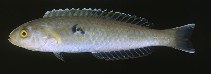
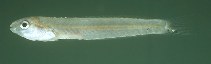
Ammolabrus dicrus, Sand wrasse

Ammolabrus dicrus Randall & Carlson, 1997

Sand wrasse
เพิ่มการสังเกตของคุณใน Fish Watcher
Native range | All suitable habitat | Point map | Year 2050
This map was computer-generated and has not yet been reviewed.
Ammolabrus dicrus   AquaMaps   Data sources: GBIF OBIS
อัพโหลดของคุณ ภาพถ่าย และ วิดีโอ
รูปภาพหลายรูป | Google image

การจำแนกประเภท / ชื่อ ชื่อสามัญ | ชื่อพ้อง | Catalog of Fishes(สกุล, ชนิด) | ITIS | CoL | WoRMS | Cloffa

> Eupercaria/misc (Various families in series Eupercaria) > Labridae (Wrasses) > Xyrichtyinae
Etymology: Ammolabrus: Greek, ammos = sand + see Labrusdicrus: From the Greek dikros, forked, in reference to the forked caudal fin.
More on authors: Randall & Carlson.

สิ่งแวดล้อม : สิ่งแวดล้อม / เขตภูมิอากาศ / ระดับความลึก / ระยะการกระจายสินค้า นิเวศวิทยา

เกี่ยวกับทะเล,น้ำเค็ม กลุ่มสัตว์หน้าดิน,กลุ่มสัตว์พื้นท้องน้ำ; ระดับความลึก 7 - 18 m (Ref. 26794). Tropical

การแพร่กระจาย อาณาเขต | พื้นที่จำแนกตาม FAO | ระบบนิเวศหลายระบบ | การปรากฏขึ้น,การเกิดขึ้น,พบ | ตำแหน่งบนแผนที่ | การแนะนำ | Faunafri

Eastern Central Pacific: known only from O'ahu, Hawaiian Islands.

ขนาด / น้ำหนัก / อายุ

วัยเจริญพันธุ์: Lm ?  range ? - ? cm
Max length : 9.4 cm SL เพศผู้/กระเทย; (Ref. 26794)

คำอธิบายสั้นๆ เครื่องมือที่ใช้ในการแยกชนิดสัตว์,สิ่งมีชีวิตออกจากกัน | สัณฐานวิทยา | ความยาวต่างๆ

เงี่ยงครีบหลัง (รวม) : 9; ก้านครีบอ่อนที่หาง (รวม) : 12; เงี่ยงครีบก้น: 3; ก้านครีบอ่อนที่ก้น: 12; สัตว์มีกระดูกสันหลัง: 25. Flexible anal fin spines; 19 or 20 + 5 or 6 pored lateral line scales with single horizontal tubule, ending in a pore; scales thin and rhomboidal, those of thorax and anterior abdomen smaller than those of side of body; head naked except for 2 small scales dorsally on opercle and diagonal row of 5 partially embedded scales behind eye; no median predorsal scales; 3 small median prepelvic scales; anterior third of prepelvic region naked; branchiostegal rays 6; upper jaw strongly protrusible, median process of premaxilla extending to above anterior pupil edge; body moderately elongate, the depth 4.2-4.45 in SL; dorsal part of head from front of snout to origin of dorsal fin with a fleshy median ridge, the interorbital space high and triangular when viewed from the front; interorbital space narrowest anteriorly; caudal fin small, 1.45-1.65 in head length; pelvic fins small, 2.2-3.05 in head length (Ref. 26794).
Body shape (shape guide): elongated.

ชีววิทยา     ภาคผนวก (เช่น epibenthic)

Adults are found over open sand bottom, in small, swift-swimming schools (Ref. 26794). Feed on zooplankton above the substratum (Ref. 26794, 58466). Oviparous, distinct pairing during breeding (Ref. 205).

วงจรชีวิตและพฤติกรรมการผสมพันธุ์ วัยเจริญพันธุ์ | การสืบพันธุ์ | การวางไข่ | เซลสืบพันธ์ของเพศเมีย(ไข่) | ความดกของไข่ | ตัวอ่อน

Oviparous, distinct pairing during breeding (Ref. 205).

อ้างอิงหลัก อัพโหลดข้อมูลอ้างอิงของคุณ | อ้างอิง | ผู้ประสานงาน : Westneat, Mark | ผู้ร่วมมือ

Parenti, P. and J.E. Randall, 2000. An annotated checklist of the species of the labroid fish families Labridae and Scaridae. Ichthyol. Bull. J.L.B. Smith Inst. Ichthyol. (68):1-97. (Ref. 35918)

สถานะบัญชีแดงของ IUCN (Ref. 130435: Version 2025-2 (Global))

  Least Concern (LC) ; Date assessed: 12 July 2008

CITES

Not Evaluated

CMS (Ref. 116361)

Not Evaluated

ภัยคุกคามต่อมนุษย์

  Harmless


การใช้ของมนุษย์

FAO - Publication: search | FishSource |

ข้อมูลเพิ่มเติม

นิเวศวิทยาเขตร้อน
รายการอาหาร (เหยื่อ)
องค์ประอบของอาหาร
การบริโภคอาหาร
การจัดสรรอาหาร
ผู้ล่า
นิเวศวิทยา
นิเวศวิทยา
พลวัตของประชากร
พารามิเตอร์การเจริญเติบโต
อายุสูงสุด / ขนาด
ความยาว-น้ำหนักสัมพันธ์
ความยาว-ความยาวสัมพันธ์
ความยาว-ความถี่
การแปลงมวล
การทดแทนที่
อุดมสมบรูณ์
วงจรชีวิต
การสืบพันธุ์
วัยเจริญพันธุ์
ความสมบูรณ์พันธุ์/เหงือกที่เกี่ยวข้อง
ความดกของไข่
การวางไข่
การรวมตัวของสปอน
เซลสืบพันธ์ของเพศเมีย(ไข่)
การพัฒนาไข่
ตัวอ่อน
พลวัตของสัตว์น้ำวัยอ่อน
การแพร่กระจาย
อาณาเขต
พื้นที่จำแนกตาม FAO
ระบบนิเวศหลายระบบ
การปรากฏขึ้น,การเกิดขึ้น,พบ
การแนะนำ
BRUVS - วิดีโอ
กายวิภาคศาสตร์
พื้นที่เหงือก
สมอง
หินโสต
สรีรวิทยา
องค์ประกอบของร่างกาย
สารอาหาร
การใช้ออกซิเจน
ประเภทการว่ายน้ำ
ระดับความเร็วในการว่ายน้ำ
เม็ดสีที่มองเห็นได้
เสียงปลา
โรคและปรสิต
ความเป็นพิษ (LC50s)
พันธุศาสตร์
จีโนม
พันธุศาสตร์
ความไม่สมดุลทางเชื้อชาติ
อัตราพันธุกรรม
ความหลากหลายทางพันธุกรรม
เกี่ยวข้องกับมนุษย์
ระบบการเพาะเลี้ยงสัตว์น้ำ
ประวัติการเพาะเลี้ยงสัตว์น้ำ
สายพันธุ์
กรณีซิเกวเทอรา
แสตมป์ เหรียญ อื่นๆ
การเข้าถึง
ผู้ร่วมมือ
อ้างอิง
อ้างอิง

เครื่องมือ

รายงานพิเศษ

ดาวน์โหลด XML

แหล่งที่มาจากอินเตอร์เน็ต

AFORO (otoliths) | Aquatic Commons | BHL | Cloffa | Websites from users | Check FishWatcher | CISTI | Catalog of Fishes: สกุล, ชนิด | DiscoverLife | ECOTOX | FAO - Publication: search | Faunafri | Fishipedia | Fishtrace | GloBI | Google Books | Google Scholar | Google | IGFA World Record | OneZoom | Open Tree of Life | Otolith Atlas of Taiwan Fishes | PubMed | Reef Life Survey | Socotra Atlas | TreeBase | แผนภูมิชีวิตแบบต้นไม้ | Wikipedia: Go, ค้นหา | World Records Freshwater Fishing | Zoobank | บันทึกทางด้านสัตววิทยา

การประมาณค่าตามแบบจำลอง

ดัชนีความหลากหลายทางวิวัฒนาการ (อ้างอิง 82804):  PD50 = 1.0000   [Uniqueness, from 0.5 = low to 2.0 = high].
Bayesian length-weight: a=0.00661 (0.00272 - 0.01607), b=3.05 (2.84 - 3.26), in cm total length, based on LWR estimates for this (Sub)family-body shape (Ref. 93245).
ระดับชั้นอาหาร (อ้างอิง 69278):  3.3   ±0.5 se; based on size and trophs of closest relatives
ความสามารถในการกลับคืนสู่ปกติ (อ้างอิง 120179):  ความสูง, เวลาต่ำสุดที่จะทำให้ประชากรเพิ่มขึ้นเป็น 2 เท่าใช้เวลาน้อยกว่า 15 เดือน (Preliminary K or Fecundity.).
ความเสี่ยงต่อการตกปลา (Ref. 59153):  Low vulnerability (10 of 100). 🛈