



Загрузить свой Фото и Видео
изображения | Изображение на Google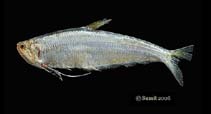 Setipinna phasa
Изображение сделано Sen, S.K.
изображения | Изображение на Google
Изображение сделано Sen, S.K.
Классификация / Имена народные названия | синонимы | Catalog of Fishes(род, виды) | ITIS | CoL | WoRMS | Cloffa
> Clupeiformes (Herrings) > Engraulidae (Anchovies) > Coiliinae
Etymology: Setipinna: Latin, septem = seven + Latin, pinna, -ae = fin.
More on author: Hamilton.
Etymology: Setipinna: Latin, septem = seven + Latin, pinna, -ae = fin.
More on author: Hamilton.
Окружающая среда: среда / климатическая зона / пределы глубины / диапазон распространения экология
; пресноводный; солоноватоводный пелагический; амфидромный (Ref. 51243). Subtropical; 30°N - 6°N, 84°E - 100°E
распространение Территории | регионы FAO | Экосистемы | места находок | карта точек | интродукции | Faunafri
Asia: Indian fresh and brackish waters (Ganges system, from Diamond Harbor on the Hooghly to as far up as Allahabad on the Ganges, perhaps further; also rivers and estuaries of Orissa). Reported from Bangladesh and Myanmar (Ref. 45255).
Длина при первой зрелости / Размер / Вес / Возраст
Краткое описание определительные ключи | морфология | морфометрия
колючие лучи спинного плавника (общее число) : 0; колючие лучи анального плавника: 0; членистые (мягкие) лучи анального плавника: 66 - 78. Belly with 21 or 22 keeled scutes from isthmus to anus. Lower gill rakers with the serrae even or becoming clumped in some specimens. Pectoral filament long, reaching to base of 15th to 39th anal fin ray. Anal fin with upper caudal lobe truncated, shorter than lower. Pectoral fins hyaline, but dark in fishes over 13.6 cm SL.
Body shape (shape guide): fusiform / normal; Cross section: compressed.
Body shape (shape guide): fusiform / normal; Cross section: compressed.
A riverine species, but also found in estuaries and presumably tolerating some salinity. Adults feed mainly on mysids and small prawns (reduced feeding during breeding), juveniles mainly on copepods. Possibly breeds throughout the year, with peaks in October and November (Hooghly at Barrackpore) or March-May (Ganges at Allahabad). Its large size makes it an attractive foodfish.
Жизненный цикл и брачное поведение половая зрелость | размножение | нерест | икра | Плодовитость | личинки
Has an extended breeding season, possibly throughout the year.
Основная ссылка
Загрузите свои рекомендации | ссылки | координатор | соавторы
Whitehead, P.J.P., G.J. Nelson and T. Wongratana, 1988. FAO Species Catalogue. Vol. 7. Clupeoid fishes of the world (Suborder Clupeoidei). An annotated and illustrated catalogue of the herrings, sardines, pilchards, sprats, shads, anchovies and wolf-herrings. FAO Fish. Synop. 125(7/2):305-579. Rome: FAO. (Ref. 189)
Статус Красного Списка МСОП (Ref. 130435: Version 2025-2 (Global))
Не вызывающий беспокойства (LC) ; Date assessed: 04 December 2019
CITES
Not Evaluated
Угроза для людей
Harmless
Использование человеком
рыболовство: не имеет хозяйственного значения
FAO - Publication: search | FishSource |
дополнительная информация
Трофическая экология
Пищевые предметы (добыча)
состав пищи
потребление пищи
Продовольственные пайки
хищники
Пищевые предметы (добыча)
состав пищи
потребление пищи
Продовольственные пайки
хищники
Динамика численности населения
Параметры роста
Макс. возраст / размер
Отношение длины к весу.
Отношение длины к длине.
Размерный состав
Преобразование массы
пополнение
численность
Параметры роста
Макс. возраст / размер
Отношение длины к весу.
Отношение длины к длине.
Размерный состав
Преобразование массы
пополнение
численность
Жизненный цикл
размножение
половая зрелость
Зрелость/Жиры относительно.
Плодовитость
нерест
Нерестовые скопления
икра
Развитие икры
личинки
динамика численности личинок
размножение
половая зрелость
Зрелость/Жиры относительно.
Плодовитость
нерест
Нерестовые скопления
икра
Развитие икры
личинки
динамика численности личинок
Анатомия
жаберная область
Мозг
Отолит
жаберная область
Мозг
Отолит
Физиология
Состав тела
Питательные вещества
Потребление кислорода
Тип плавания
Скорость плавания
Зрительные пигменты
Звук рыбы
Болезни и паразиты
Токсичность (LC50s)
Состав тела
Питательные вещества
Потребление кислорода
Тип плавания
Скорость плавания
Зрительные пигменты
Звук рыбы
Болезни и паразиты
Токсичность (LC50s)
генетика
Геном
генетика
Гетерозиготность
наследуемость
Генетическое разнообразие
Геном
генетика
Гетерозиготность
наследуемость
Генетическое разнообразие
Связанные с человеком
Системы аквакультуры
особенности рыбоводства
степень растяжения
Случаи заболевания сигуатерой
Марки, монеты и прочее.
Системы аквакультуры
особенности рыбоводства
степень растяжения
Случаи заболевания сигуатерой
Марки, монеты и прочее.
инструменты
Специальные отчеты
Проверить содержание в аквариумах | Проверить опубликованные видовые данные | Проверить опубликованные данные по аквакультуре
Скачать в формате XML
ресурсы в Интернет
AFORO (otoliths) | Aquatic Commons | BHL | Cloffa | Websites from users | Проверить FishWatcher | CISTI | Catalog of Fishes: род, виды | DiscoverLife | ECOTOX | FAO - Publication: search | Faunafri | Fishipedia | Fishtrace | GloBI | Google Books | Google Scholar | Google | IGFA World Record | OneZoom | Open Tree of Life | Otolith Atlas of Taiwan Fishes | PubMed | Reef Life Survey | Socotra Atlas | TreeBase | Tree of Life | Wikipedia: Вперёд, поиск | World Records Freshwater Fishing | Зоологическая летопись
Оценки, основанные на моделях
Индекс филогенетического разнообразия (ссылка 82804): PD50 = 0.5039 [Uniqueness, from 0.5 = low to 2.0 = high].
Bayesian length-weight: a=0.00407 (0.00246 - 0.00675), b=3.09 (2.95 - 3.23), in cm total length, based on LWR estimates for this species & (Sub)family-body (Ref. 93245).
Трофический уровень (ссылка 69278): 3.3 ±0.40 se; based on food items.
Generation time: 4.5 ( na - na) years. Estimated as median ln(3)/K based on 1 growth studies.
устойчивость к внешним воздействиям (ссылка 120179): средний (среднего размера), минимальное время удвоения популяции 1.4-4.4 года (K=0.24).
Питательные вещества (Ref. 124155): Calcium = 103 [33, 282] mg/100g; Iron = 1.55 [0.73, 3.12] mg/100g; Protein = 20.5 [18.6, 22.3] %; Omega3 = 0.666 [0.379, 1.333] g/100g; Selenium = 18.4 [9.3, 36.9] μg/100g; VitaminA = 3.3 [0.9, 13.5] μg/100g; Zinc = 1.02 [0.47, 2.86] mg/100g (wet weight); based on nutrient studies.