



Microcambeva ribeirae Costa, Lima & Bizerril, 2004
Envoyez vos Photos et vidéos
Images Google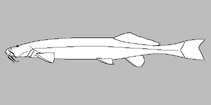 No image available for this species;
drawing shows typical species in Trichomycteridae.
Images Google
drawing shows typical species in Trichomycteridae.
Classification / Noms Noms communs | Synonymes | Catalog of Fishes(Genre, Espèce) | ITIS | CoL | WoRMS | Cloffa
> Siluriformes (Catfishes) > Trichomycteridae (Pencil or parasitic catfishes) > Microcambevinae
Etymology: Microcambeva: Greek, mikros = small + cambeva, a Tupí-Guaraní word = flattened head; ribeirae: Named for its type locality, Ribeira do Iguape.
Eponymy: In the case of the catfish and cichlid, this is a toponym referring to the Rio Ribeira de Iguape, a river basin in Brazil, which is the type locality. [...] (Ref. 128868), visit book page.
More on authors: Costa, Lima & Bizerril.
Etymology: Microcambeva: Greek, mikros = small + cambeva, a Tupí-Guaraní word = flattened head; ribeirae: Named for its type locality, Ribeira do Iguape.
Eponymy: In the case of the catfish and cichlid, this is a toponym referring to the Rio Ribeira de Iguape, a river basin in Brazil, which is the type locality. [...] (Ref. 128868), visit book page.
More on authors: Costa, Lima & Bizerril.
Environnement : milieu / zone climatique / profondeur / gamme de distribution Écologie
; eau douce démersal. Subtropical
Distribution Territoires | Zones FAO | Écosystèmes | Occurrences | Carte par point | Introductions | Faunafri
South America: Rio Ribeira do Iguape basin in southeastern Brazil.
Taille / Poids / Âge
Description synthétique Clés d'identification | Morphologie | Morphométrie
Rayons mous dorsaux (Total) : 9; Rayons mous anaux: 8; Vertèbres: 34. Differs from M. barbata in having short nasal barbels reaching just behind posterior nostril; eye positioned on posterior half of head; first pectoral-fin ray shorter than posterior ones, its tip not forming a distinct filament; anal fin origin posterior of vertical through base of last dorsal-fin ray; posteriormost pore of each supraorbital canal united in the midline, composing a single median pore; frontal elongated anteriorly; fontanel not extending anteriorly beyond posteriormost supraorbital pore; anterior portion of sphenotic with a prominent lateral process; anterior palatine ossification absent; posterior process of palatine elongate, about 60% of palatine bony portion without posterior process; and supraorbital bone elongate, about three times as long as lacrimal (Ref. 53272).
Body shape (shape guide): elongated.
Body shape (shape guide): elongated.
Occurs in clear, shallow streams (about 60 cm deep), with a gray sandy bottom, where some specimens were found entirely buried, except for snout and barbels (Ref. 53272).
Cycle de vie et comportement reproducteur Maturité | Reproduction | Frai | Œufs | Fécondité | Larves
Référence principale
Téléchargez vos références | Références | Coordinateur : Pinna, Mário de | Collaborateurs
Costa, W.J.E.M., S.M.Q. Lima and C.R.S.F. Bizerril, 2004. Microcambeva ribeirae sp. n. (Teleostei: Siluriformes: Trichomycteridae): a new sarcoglanidine catfish from the Rio Ribeira do Iguape basin, southeastern Brazil. Zootaxa 563:1-10. (Ref. 53272)
Statut dans la liste rouge de l'IUCN (Ref. 130435: Version 2025-2 (Global))
Préoccupation mineure (LC) ; Date assessed: 18 May 2022
CITES
Not Evaluated
Menace pour l'homme
Harmless
Utilisations par l'homme
Pêcheries: sans intérêt
FAO - Publication: search | FishSource |
Plus d'informations
Écologie trophique
Aliments (proies)
Composition du régime alimentaire
Consommation alimentaire
Rations alimentaires
Prédateurs
Aliments (proies)
Composition du régime alimentaire
Consommation alimentaire
Rations alimentaires
Prédateurs
Écologie
Écologie
Écologie
Dynamique des populations
Paramètres de croissance
Âges / tailles maximales
Longueur-poids rel.
Rel. longueur-longueur.
Fréquences de longueurs
Conversion de masse
Recrutement
Abondance
Paramètres de croissance
Âges / tailles maximales
Longueur-poids rel.
Rel. longueur-longueur.
Fréquences de longueurs
Conversion de masse
Recrutement
Abondance
Cycle de vie
Reproduction
Maturité
Maturité/épines rel.
Fécondité
Frai
Agrégats de frai
Œufs
Développement de l'œuf
Larves
Dynamique des populations larvaires
Reproduction
Maturité
Maturité/épines rel.
Fécondité
Frai
Agrégats de frai
Œufs
Développement de l'œuf
Larves
Dynamique des populations larvaires
Anatomie
Surface branchiale
Cerveau
Otolithe
Surface branchiale
Cerveau
Otolithe
Physiologie
Composition corporelle
Nutriments
Consommation d'oxygène
Type de natation
Vitesse de nage
Pigments visuels
Son de poisson
Maladies et parasites
Toxicité (CL50)
Composition corporelle
Nutriments
Consommation d'oxygène
Type de natation
Vitesse de nage
Pigments visuels
Son de poisson
Maladies et parasites
Toxicité (CL50)
Génétique
génôme
Génétique
Hétérozygotie
Héritabilité
Diversité génétique
génôme
Génétique
Hétérozygotie
Héritabilité
Diversité génétique
Liées à l'homme
Systèmes d'aquaculture
Profils d'aquaculture
Souches
Cas de ciguatera
Timbres, pièces de monnaie, divers
Systèmes d'aquaculture
Profils d'aquaculture
Souches
Cas de ciguatera
Timbres, pièces de monnaie, divers
Outils
E-book | Guide de terrain | Générateur de fréquences de longueur | Outil de dynamique de population | Carte par point |
Capture-MSY |
Articles particuliers
Télécharger en XML
Sources Internet
AFORO (otoliths) | Aquatic Commons | BHL | Cloffa | Websites from users | FishWatcher | CISTI | Catalog of Fishes: Genre, Espèce | DiscoverLife | ECOTOX | FAO - Publication: search | Faunafri | Fishipedia | Fishtrace | GloBI | Google Books | Google Scholar | Google | IGFA World Record | OneZoom | Open Tree of Life | Otolith Atlas of Taiwan Fishes | PubMed | Reef Life Survey | Socotra Atlas | TreeBase | Arbre de Vie | Wikipedia: aller à, chercher | World Records Freshwater Fishing | Zoobank | Zoological Record
Estimations basées sur des modèles
Indice de diversité phylogénétique (Réf. 82804): PD50 = 0.6250 [Uniqueness, from 0.5 = low to 2.0 = high].
Bayesian length-weight: a=0.00389 (0.00180 - 0.00842), b=3.12 (2.94 - 3.30), in cm total length, based on all LWR estimates for this body shape (Ref. 93245).
Niveau trophique (Réf. 69278): 3.1 ±0.4 se; based on size and trophs of closest relatives