



Megalobrama mantschuricus (Basilewsky, 1855)
Hochladen Photos und videos
Google Bild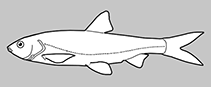 No image available for this species;
drawing shows typical species in Xenocyprididae.
Google Bild
drawing shows typical species in Xenocyprididae.
Klassifizierung / Names Namen | Synonyme | Catalog of Fishes(Gattung, Arten) | ITIS | CoL | WoRMS | Cloffa
> Cypriniformes (Carps) > Xenocyprididae (East Asian minnows)
Etymology: Megalobrama: Greek, megalos = great + old French breme, bresme, a fresh water fish; 1460 (Ref. 45335).
Etymology: Megalobrama: Greek, megalos = great + old French breme, bresme, a fresh water fish; 1460 (Ref. 45335).
Umwelt: Milieu / Klimazone / Tiefenbereich / Verbreitungsgebiet Ökologie
; süßwasser benthopelagisch. Subtropical
Verbreitung Territorien | FAO Gebiete | Ökosysteme | Vorkommen | Punkt Karte | Einführungen | Faunafri
Asia: Amur River southward to the Yangtze River drainage and rivers further southward draining to the South China Sea, excluding Zhu Jiang and Xi Jiang.
Länge bei der ersten Reifung / Größe / Gewicht / Alter
Kurzbeschreibung Bestimmungsschlüssel | Morphologie | Morphometrie
Rückenflossenstacheln (insgesamt) : 3; Rückenflossenweichstrahlen (insgesamt) : 7 - 8; Afterflossenstacheln: 3; Afterflossenweichstrahlen: 28 - 33; Wirbelzahl: 37 - 41. Distinguished by the following characters: vertebrae (without 4 vertebrae of the Weberian apparatus) not exceeding 37; for fishes with over 15 cm body length, there are 7-9 longitudinal rows of scales between the lateral line and insertion of the ventral fin; body depth 1.7-2.5 in l; length of dorsal spine exceeds that of head, depth of caudal peduncle is as a rule less than its length, width of oral slit is less than two times in head width; corneous sheaths usually thin, on upper jaw appear as a thin crescent (distinct in small specimens), rarer triangular; supraorbitale in small specimens relatively narrow, like a thin crescent, in large specimens it is triangular or trapezoid; the swim bladder is three chambered, the third chamber is usually very reduced; the anterior body outline in adults usually has a clearly seen depression at the level of the end of the head followed by an abruptly ascending "hump", depth of the head at the level of this depression frequently makes up 40% of the greatest body depth. In adults (1>15 cm) on scales in the anterior body sides (including scales of the lateral line and several rows above and below the lateral line) in the posterior (outer) part there is an opaque sector with black dots either all over this sector or only along its posterior margin; the dorsal side very dark, almost black, the sides and belly slightly lighter (Ref. 51498).
Usually does not occur in main channel of the river but in the system of auxiliary waters with aquatic vegetation and conditions suitable for feeding and reproduction (Ref. 51498). Feeds principally on mollusks, but also takes filamentous algae, higher plants, crustaceans, insect larvae and small fish (Ref. 51498).
Lebenszyklus und Paarungsverhalten Geschlechtsreife | Fortpflanzung | Ablaichen | Eier | Fruchtbarkeit | Larven
Hauptreferenz
Laden Sie Ihre Referenzen hoch | Referenzen | Koordinator | Partner
Vasil'eva, E.D. and A.P. Makeeva, 2003. Taxonomic status of the Black Amur bream and some remarks on problems of taxonomy of the genera Megalobrama and Sinibrama (Cyprinidae, Cultrinae). J. Ichthyol. 43(8):582-597. (Ref. 51498)
IUCN Rote Liste Status (Ref. 130435: Version 2025-2 (Global))
nicht bedroht (LC) ; Date assessed: 08 June 2020
CITES
Not Evaluated
Bedrohung für Menschen
Harmless
Nutzung durch Menschen
FAO - Publication: search | FishSource |
Mehr Information
Trophische Ökologie
Lebensmittel (Beutetiere)
Nahrungszusammensetzung
Nahrungsaufnahme
Lebensmittelrationen
Räuber
Lebensmittel (Beutetiere)
Nahrungszusammensetzung
Nahrungsaufnahme
Lebensmittelrationen
Räuber
Populationsdynamik
Wachstumsparameter
Max. Alter/Größen
Länge-Gewicht-Rel.
Länge-Länge-Verhältnis.
Längenhäufigkeiten
Massenkonvertierung
Rekrutierung
Dichte
Wachstumsparameter
Max. Alter/Größen
Länge-Gewicht-Rel.
Länge-Länge-Verhältnis.
Längenhäufigkeiten
Massenkonvertierung
Rekrutierung
Dichte
Lebenszyklus
Fortpflanzung
Geschlechtsreife
Reifung/Kiemen rel.
Fruchtbarkeit
Ablaichen
Laichaggregationen
Eier
Eientwicklung
Larven
Larven Pop.Dyn.
Fortpflanzung
Geschlechtsreife
Reifung/Kiemen rel.
Fruchtbarkeit
Ablaichen
Laichaggregationen
Eier
Eientwicklung
Larven
Larven Pop.Dyn.
Anatomie
Kiemenoberfläche
Gehirn
Otolith
Kiemenoberfläche
Gehirn
Otolith
Physiologie
Körperliche Zusammensetzung
Nährstoffe
Sauerstoffverbrauch
Schwimmart
Schwimmgeschwindigkeit
Visuelle Pigmente
Fischgeräusche
Krankheiten und Parasiten
Toxizität (LC50s)
Körperliche Zusammensetzung
Nährstoffe
Sauerstoffverbrauch
Schwimmart
Schwimmgeschwindigkeit
Visuelle Pigmente
Fischgeräusche
Krankheiten und Parasiten
Toxizität (LC50s)
Genetik
Genom
Genetik
Heterozygotie
Vererbbarkeit
Genetische Vielfalt
Genom
Genetik
Heterozygotie
Vererbbarkeit
Genetische Vielfalt
Menschenbezogen
Aquakultur-Systeme
Aquakultur Profile
Zuchtlinien
Ciguatera-Fälle
Briefmarken, Münzen, Verschiedenes.
Aquakultur-Systeme
Aquakultur Profile
Zuchtlinien
Ciguatera-Fälle
Briefmarken, Münzen, Verschiedenes.
Tools
E-Book | Feldführer | Bestimmungsschlüssel | Längenhäufigkeits Tool | Lebensdaten Tool | Punkt Karte |
Catch-MSY |
Zusatzinformationen
Download XML
Zusammenfassung | Punktdaten | Namen | Photos
Internet Quellen
AFORO (otoliths) | Aquatic Commons | BHL | Cloffa | Websites from users | FishWatcher Einträge suchen | CISTI | Catalog of Fishes: Gattung, Arten | DiscoverLife | ECOTOX | FAO - Publication: search | Faunafri | Fishipedia | Fishtrace | GloBI | Google Books | Google Scholar | Google | IGFA World Record | OneZoom | Open Tree of Life | Otolith Atlas of Taiwan Fishes | PubMed | Reef Life Survey | Socotra Atlas | TreeBase | Tree of Life | Wikipedia: Gehe zu, Suchen | World Records Freshwater Fishing | Zoologischer Rekord
Schätzungen auf der Grundlage von Modellen
Phylogenetischer Diversitätsindex (Ref. 82804): PD50 = 0.5312 [Uniqueness, from 0.5 = low to 2.0 = high].
Bayesian length-weight: a=0.01549 (0.00820 - 0.02927), b=3.06 (2.89 - 3.23), in cm total length, based on LWR estimates for this species & (Sub)family-body (Ref. 93245).
Trophische Ebene (Ref. 69278): 3.3 ±0.46 se; based on food items.
Widerstandsfähigkeit (Ref. 120179): mittel, Verdopplung der Population dauert 1,4 - 4,4 Jahre. (tm=3-6; Fec=177,000).