



Phalloceros aspilos Lucinda, 2008
Envoyez vos Photos et vidéos
Images | Images Google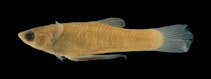 Phalloceros aspilos
Male Photo de Lucinda, P.H.F.
Images | Images Google
Male Photo de Lucinda, P.H.F.
Classification / Noms Noms communs | Synonymes | Catalog of Fishes(Genre, Espèce) | ITIS | CoL | WoRMS | Cloffa
> Cyprinodontiformes (Rivulines, killifishes and live bearers) > Poeciliidae (Poeciliids) > Poeciliinae
Etymology: Phalloceros: Greek, phallos = penis + Greek, keras = horn (Ref. 45335); aspilos: From the Greek, aspilos meaning stainless, without spots, spotless; alluding to the absence of the lateral spot.
Etymology: Phalloceros: Greek, phallos = penis + Greek, keras = horn (Ref. 45335); aspilos: From the Greek, aspilos meaning stainless, without spots, spotless; alluding to the absence of the lateral spot.
Environnement : milieu / zone climatique / profondeur / gamme de distribution Écologie
; eau douce pélagique. Tropical
Distribution Territoires | Zones FAO | Écosystèmes | Occurrences | Carte par point | Introductions | Faunafri
South America: Brazil: Rio Parati-Mirim, Rio de Janeiro (Ref. 76852).
Taille / Poids / Âge
Maturité: Lm ? range ? - ? cm
Max length : 2.4 cm SL mâle / non sexé; (Ref. 76852); 3.8 cm SL (female)
Max length : 2.4 cm SL mâle / non sexé; (Ref. 76852); 3.8 cm SL (female)
Description synthétique Clés d'identification | Morphologie | Morphométrie
Rayons mous dorsaux (Total) : 7 - 8; Rayons mous anaux: 9 - 11; Vertèbres: 33. Diagnosed by the following uniquely derived autapomorphy: hypural plate almost bipartite, with very large aperture. P. aspilos is readily distinguished from its congeners, except P. tupinamba and P. leptokeras by the presence of a lateral ramus of the female urogenital papilla; female urogenital papilla left turned; large sickle like hook on the gonopodial appendix located in its inner surface and close to its base; and absence of inconspicuous vertical bars along body sides. Phalloceros aspilos can be distinguished from P. leptokeras and P. tupinamba by the absence of lateral spot. Phalloceros aspilos can also be distinguished from P. tupinamba by the predorsal length of males (54.8-56.3 vs. 57.5-59.7 % SL, respectively) (Ref. 76852).
Cycle de vie et comportement reproducteur Maturité | Reproduction | Frai | Œufs | Fécondité | Larves
Référence principale
Téléchargez vos références | Références | Coordinateur | Collaborateurs
Lucinda, P.H.F., 2008. Systematics and biogeography of the genus Phalloceros Eigenmann, 1907 (Cyprinodontiformes: Poeciliidae: Poeciliinae), with the description of twenty-one new species. Neotrop. Ichthyol. 6(2):113-158. (Ref. 76852)
Statut dans la liste rouge de l'IUCN (Ref. 130435: Version 2025-2 (Global))
Préoccupation mineure (LC) ; Date assessed: 07 November 2018
CITES
Not Evaluated
Menace pour l'homme
Harmless
Utilisations par l'homme
FAO - Publication: search | FishSource |
Plus d'informations
Écologie trophique
Aliments (proies)
Composition du régime alimentaire
Consommation alimentaire
Rations alimentaires
Prédateurs
Aliments (proies)
Composition du régime alimentaire
Consommation alimentaire
Rations alimentaires
Prédateurs
Écologie
Écologie
Écologie
Dynamique des populations
Paramètres de croissance
Âges / tailles maximales
Longueur-poids rel.
Rel. longueur-longueur.
Fréquences de longueurs
Conversion de masse
Recrutement
Abondance
Paramètres de croissance
Âges / tailles maximales
Longueur-poids rel.
Rel. longueur-longueur.
Fréquences de longueurs
Conversion de masse
Recrutement
Abondance
Cycle de vie
Reproduction
Maturité
Maturité/épines rel.
Fécondité
Frai
Agrégats de frai
Œufs
Développement de l'œuf
Larves
Dynamique des populations larvaires
Reproduction
Maturité
Maturité/épines rel.
Fécondité
Frai
Agrégats de frai
Œufs
Développement de l'œuf
Larves
Dynamique des populations larvaires
Anatomie
Surface branchiale
Cerveau
Otolithe
Surface branchiale
Cerveau
Otolithe
Physiologie
Composition corporelle
Nutriments
Consommation d'oxygène
Type de natation
Vitesse de nage
Pigments visuels
Son de poisson
Maladies et parasites
Toxicité (CL50)
Composition corporelle
Nutriments
Consommation d'oxygène
Type de natation
Vitesse de nage
Pigments visuels
Son de poisson
Maladies et parasites
Toxicité (CL50)
Génétique
génôme
Génétique
Hétérozygotie
Héritabilité
Diversité génétique
génôme
Génétique
Hétérozygotie
Héritabilité
Diversité génétique
Liées à l'homme
Systèmes d'aquaculture
Profils d'aquaculture
Souches
Cas de ciguatera
Timbres, pièces de monnaie, divers
Systèmes d'aquaculture
Profils d'aquaculture
Souches
Cas de ciguatera
Timbres, pièces de monnaie, divers