



Hochladen Photos und videos
Bilder | Google Bild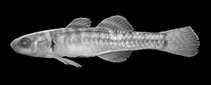 Hypseleotris barrawayi
Male Photo von Larson, H.K.
Bilder | Google Bild
Male Photo von Larson, H.K.
Klassifizierung / Names Namen | Synonyme | Catalog of Fishes(Gattung, Arten) | ITIS | CoL | WoRMS | Cloffa
> Gobiiformes (Gobies) > Eleotridae (Bully sleepers)
Etymology: Hypseleotris: Greek, hypselos = high + The name of a Nile fish, eleotris (Ref. 45335); barrawayi: Named after the late Sandy Barraway, traditional owner of the Sleisbeck country, who had great knowledge of the fauna and stories associated with that country.
Eponymy: Sandy Barraway was, according to the etymology: “…the ‘traditional’ (i.e. aboriginal) owner of the Sleisbeck country (land or region), who had great knowledge of the fauna and stories associated with that country.” (Ref. 128868), visit book page.
More on author: Larson.
Etymology: Hypseleotris: Greek, hypselos = high + The name of a Nile fish, eleotris (Ref. 45335); barrawayi: Named after the late Sandy Barraway, traditional owner of the Sleisbeck country, who had great knowledge of the fauna and stories associated with that country.
Eponymy: Sandy Barraway was, according to the etymology: “…the ‘traditional’ (i.e. aboriginal) owner of the Sleisbeck country (land or region), who had great knowledge of the fauna and stories associated with that country.” (Ref. 128868), visit book page.
More on author: Larson.
Umwelt: Milieu / Klimazone / Tiefenbereich / Verbreitungsgebiet Ökologie
; süßwasser demersal; pH range: 7.3 - ? ; dH range: 11.48 - ?. Tropical
Verbreitung Territorien | FAO Gebiete | Ökosysteme | Vorkommen | Punkt Karte | Einführungen | Faunafri
Oceania: known only from upper reaches of Katherine River system in Northern Territory, Australia.
Größe / Gewicht / Alter
Kurzbeschreibung Bestimmungsschlüssel | Morphologie | Morphometrie
Rückenflossenstacheln (insgesamt) : 6 - 8; Rückenflossenweichstrahlen (insgesamt) : 9 - 11; Afterflossenstacheln: 1; Afterflossenweichstrahlen: 9 - 11; Wirbelzahl: 26 - 27. Distinguished from all other species of the genus Hypseleotris by a combination of the following characters: side of the body with distinct dark vertical bars; first and second dorsal fins banded with light and dark pigment; caudal fin plain or with several dusky bars or rows of spots; dark bar on pectoral base darkest dorsally and diffuse on ventral part of fin base; 26 vertebrae; preopercle with scales; postdorsal scale count usually 9, lateral scale count 30-34, usually 32, and predorsal scales scattered along midline of nape and/or above opercle and preopercle, not reaching eyes and often absent altogether (Ref. 76845).
Body shape (shape guide): fusiform / normal.
Body shape (shape guide): fusiform / normal.
Prefers clear quiet water with sheltered places such as near steep banks with overhanging vegetation, among bankside roots, submerged logs. Reported to form large loose schools or occur in low abundance and solitary Ref. 76845).
Lebenszyklus und Paarungsverhalten Geschlechtsreife | Fortpflanzung | Ablaichen | Eier | Fruchtbarkeit | Larven
Hauptreferenz
Laden Sie Ihre Referenzen hoch | Referenzen | Koordinator | Partner
Larson, H.K., 2007. A new species of carp gudgeon, Hypseleotris (Pisces: Gobioidei: Eleotridae), from the Katherine River system, Northern Territory. The Beagle, Records of the Museums and Art Galleries of the Northern Territory 23:111-117. (Ref. 76845)
IUCN Rote Liste Status (Ref. 130435: Version 2025-2 (Global))
Gefährdung zunehmend (NT) ; Date assessed: 13 February 2019
CITES
Not Evaluated
Bedrohung für Menschen
Harmless
Nutzung durch Menschen
FAO - Publication: search | FishSource |
Mehr Information
Trophische Ökologie
Lebensmittel (Beutetiere)
Nahrungszusammensetzung
Nahrungsaufnahme
Lebensmittelrationen
Räuber
Lebensmittel (Beutetiere)
Nahrungszusammensetzung
Nahrungsaufnahme
Lebensmittelrationen
Räuber
Ökologie
Ökologie
Ökologie
Populationsdynamik
Wachstumsparameter
Max. Alter/Größen
Länge-Gewicht-Rel.
Länge-Länge-Verhältnis.
Längenhäufigkeiten
Massenkonvertierung
Rekrutierung
Dichte
Wachstumsparameter
Max. Alter/Größen
Länge-Gewicht-Rel.
Länge-Länge-Verhältnis.
Längenhäufigkeiten
Massenkonvertierung
Rekrutierung
Dichte
Lebenszyklus
Fortpflanzung
Geschlechtsreife
Reifung/Kiemen rel.
Fruchtbarkeit
Ablaichen
Laichaggregationen
Eier
Eientwicklung
Larven
Larven Pop.Dyn.
Fortpflanzung
Geschlechtsreife
Reifung/Kiemen rel.
Fruchtbarkeit
Ablaichen
Laichaggregationen
Eier
Eientwicklung
Larven
Larven Pop.Dyn.
Anatomie
Kiemenoberfläche
Gehirn
Otolith
Kiemenoberfläche
Gehirn
Otolith
Physiologie
Körperliche Zusammensetzung
Nährstoffe
Sauerstoffverbrauch
Schwimmart
Schwimmgeschwindigkeit
Visuelle Pigmente
Fischgeräusche
Krankheiten und Parasiten
Toxizität (LC50s)
Körperliche Zusammensetzung
Nährstoffe
Sauerstoffverbrauch
Schwimmart
Schwimmgeschwindigkeit
Visuelle Pigmente
Fischgeräusche
Krankheiten und Parasiten
Toxizität (LC50s)
Genetik
Genom
Genetik
Heterozygotie
Vererbbarkeit
Genetische Vielfalt
Genom
Genetik
Heterozygotie
Vererbbarkeit
Genetische Vielfalt
Menschenbezogen
Aquakultur-Systeme
Aquakultur Profile
Zuchtlinien
Ciguatera-Fälle
Briefmarken, Münzen, Verschiedenes.
Aquakultur-Systeme
Aquakultur Profile
Zuchtlinien
Ciguatera-Fälle
Briefmarken, Münzen, Verschiedenes.
Tools
Zusatzinformationen
Download XML
Zusammenfassung | Punktdaten | Namen | Photos
Internet Quellen
AFORO (otoliths) | Aquatic Commons | BHL | Cloffa | Websites from users | FishWatcher Einträge suchen | CISTI | Catalog of Fishes: Gattung, Arten | DiscoverLife | ECOTOX | FAO - Publication: search | Faunafri | Fishipedia | Fishtrace | GloBI | Google Books | Google Scholar | Google | IGFA World Record | OneZoom | Open Tree of Life | Otolith Atlas of Taiwan Fishes | PubMed | Reef Life Survey | Socotra Atlas | TreeBase | Tree of Life | Wikipedia: Gehe zu, Suchen | World Records Freshwater Fishing | Zoobank | Zoologischer Rekord
Schätzungen auf der Grundlage von Modellen
Phylogenetischer Diversitätsindex (Ref. 82804): PD50 = 0.5000 [Uniqueness, from 0.5 = low to 2.0 = high].
Bayesian length-weight: a=0.00977 (0.00411 - 0.02324), b=3.08 (2.88 - 3.28), in cm total length, based on LWR estimates for this (Sub)family-body shape (Ref. 93245).
Trophische Ebene (Ref. 69278): 3.2 ±0.2 se; based on size and trophs of closest relatives
Widerstandsfähigkeit (Ref. 120179): hoch, Verdopplung der Population dauert weniger als 15 Monate. (Preliminary K or Fecundity.).