This website uses cookies to enhance your browsing experience and ensure the functionality of our site. For more detailed information about the types of cookies we use and how we protect your privacy, please visit our Privacy Information page.
×
Cookie Settings
This website uses different types of cookies to enhance your experience. Please select your preferences below:
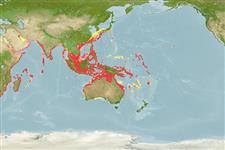
Indo-West Pacific: Red Sea south to at least Durban, South Africa and eastward to Palau and Fiji, north to the Ryukyu Islands, south to the Arafura Sea (Ref. 9819) and Australia. Recently reported from the Mediterranean coast of Israel (Ref. 5222). Frequently misidentified as Epinephelus tauvina or Epinephelus malabaricus (Ref. 27362).
Länge bei der ersten Reifung / Größe / Gewicht / Alter
Geschlechtsreife: Lm41.3, range 25 - 30 cm Max length : 120 cm TL Männchen/unbestimmt; (Ref. 47613); max. veröff. Gewicht: 15.0 kg (Ref. 11228); max. veröff. Alter: 22 Jahre (Ref. 3627)
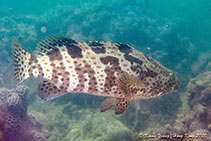
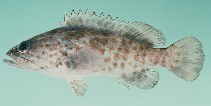
Rückenflossenstacheln (insgesamt) : 11; Rückenflossenweichstrahlen (insgesamt) : 13 - 16; Afterflossenstacheln: 3; Afterflossenweichstrahlen: 8. This species is distinguished by the following characters: elongated body with greatest body depth at 2.9-3.7 in SL (for specimens 10-78 cm SL); head length 2.3-2.6 in SL. interorbital width 5.0-6.2 in HL; preopercle with enlarged serrae at angle and a broad shallow notch just above angle; upper edge of operculum straight or somewhat convex; maxilla reaches to or slightly past a vertical at rear edge of eye; upper jaw length 17-20% of SL; midlateral part of lower jaw with 2-3 rows of subequal teeth; gill rakers of first gill arch 8-10 + 14-17; pyloric caeca 50-60; lateral body scales rough, with minute auxiliary scales (body scales ctenoid except for nape, back, thorax, abdomen and above anal-fin base with cycloid scales); lateral-line scales 58-65; lateral-line tubes of anterior scales branched in adults. Colour: head and body tan dorsally, shading to whitish ventrally; numerous small brownish orange or reddish brown spots on head, body, and median fins; body with 5 faint, irregular, oblique, dark bars which bifurcate ventrally (irregular H-shaped bars); back with 3-4 blackish saddles; orange spots become poorly defined and darker with growth (Ref. 39231, 90102). Body shape (shape guide): fusiform / normal; Cross section: compressed.
Inhabit turbid coastal reefs (Ref. 9710) and are often found in brackish water (Ref. 27362) over mud and rubble (Ref. 6390). Solitary (Ref 90102). Juveniles are common in shallow waters of estuaries over sand, mud and gravel and among mangroves (Ref. 6390). Feed on small fishes, shrimps, and crabs. Probably spawn during restricted periods and form aggregations when doing so (Ref. 27352). Females mature at 25 to 30 cm (2 to 3 years old), and sexual transition occurs at 55 to 75 cm (Ref. 39231). Eggs and early larvae are probably pelagic (Ref. 6390). Has been tested in several countries as a potential species for mariculture (Ref. 43448). Caught with hook-and-line, traps, trawls, and lift nets. Common and expensive in markets of the region; sold fresh and kept alive at restaurants in Asian countries (e.g. Hong Kong and Taiwan Province of China) (Ref. 39231).
Heemstra, P.C. and J.E. Randall, 1993. FAO Species Catalogue. Vol. 16. Groupers of the world (family Serranidae, subfamily Epinephelinae). An annotated and illustrated catalogue of the grouper, rockcod, hind, coral grouper and lyretail species known to date. Rome: FAO. FAO Fish. Synop. 125(16):382 p. (Ref. 5222)
IUCN Rote Liste Status (Ref. 130435: Version 2025-2 (Global))