



Pezichthys macropinnis Last & Gledhill, 2009
Longfin handfish
Hochladen Photos und videos
Google Bild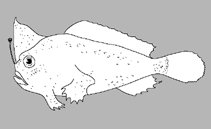 No image available for this species;
drawing shows typical species in Brachionichthyidae.
Google Bild
drawing shows typical species in Brachionichthyidae.
Klassifizierung / Names Namen | Synonyme | Catalog of Fishes(Gattung, Arten) | ITIS | CoL | WoRMS | Cloffa
> Lophiiformes (Anglerfishes) > Brachionichthyidae (Handfishes)
Etymology: Pezichthys: Name from Greek 'pezo' (walking) and 'ichthys' (fish), referring to the ability of these fishes to walk on the sea floor using their hand-like pelvic fins and arm-like pectoral fins; macropinnis: Name from Greek 'makros' (large) and the Latin 'pinna' (fin), for its tall dorsal and anal fins.
More on authors: Last & Gledhill.
Etymology: Pezichthys: Name from Greek 'pezo' (walking) and 'ichthys' (fish), referring to the ability of these fishes to walk on the sea floor using their hand-like pelvic fins and arm-like pectoral fins; macropinnis: Name from Greek 'makros' (large) and the Latin 'pinna' (fin), for its tall dorsal and anal fins.
More on authors: Last & Gledhill.
Umwelt: Milieu / Klimazone / Tiefenbereich / Verbreitungsgebiet Ökologie
seewasser demersal; tiefenbereich ? - 145 m (Ref. 82446). Temperate
Verbreitung Territorien | FAO Gebiete | Ökosysteme | Vorkommen | Punkt Karte | Einführungen | Faunafri
Eastern Indian Ocean: South Australia.
Größe / Gewicht / Alter
Kurzbeschreibung Bestimmungsschlüssel | Morphologie | Morphometrie
Rückenflossenweichstrahlen (insgesamt) : 17; Afterflossenweichstrahlen: 8. This species is distinct in having the following characters: small esca, 12% of illicium length (including esca); very elongate and slender illicium, without dermal spinules, about 26% SL in length, 1.9 times in head length; head length about 5.4 times snout length; long snout, length 9% SL; eye 6.9 times in head length; robust body, maximum width about 32% SL; interorbit broad, width about 15% SL; scales with subcircular bases, monospinulate or with prominent, strongly diverging bifurcate spinules (except for those closely associated with pores of the acoustico-lateralis system); spinules variable in length over body; dorsal-fin elements mostly lack spinules, membranes of fins naked; first dorsal-fin base about 18% SL; second dorsal-fin rays 15, fin base 63% SL; fin rays very elongate, longest ray of second dorsal fin about 35% SL; length of second dorsal-fin spine 0.9 times length of longest ray of second dorsal fin; anal-fin rays 8; pale body with a network of reddish streaks (Ref. 82446).
Body shape (shape guide): elongated.
Body shape (shape guide): elongated.
Lebenszyklus und Paarungsverhalten Geschlechtsreife | Fortpflanzung | Ablaichen | Eier | Fruchtbarkeit | Larven
Hauptreferenz
Laden Sie Ihre Referenzen hoch | Referenzen | Koordinator | Partner
Last, P. and D.C. Gledhill, 2009. A revision of the Australian handfishes (Lophiiformes: Brachionichthyidae), with descriptions of three new genera and nine new species. Zootaxa 2252:1-77. (Ref. 82446)
IUCN Rote Liste Status (Ref. 130435: Version 2025-2 (Global))
Daten mangelhaft (DD) ; Date assessed: 30 April 2018
CITES
Not Evaluated
Bedrohung für Menschen
Harmless
Nutzung durch Menschen
FAO - Publication: search | FishSource |
Mehr Information
Trophische Ökologie
Lebensmittel (Beutetiere)
Nahrungszusammensetzung
Nahrungsaufnahme
Lebensmittelrationen
Räuber
Lebensmittel (Beutetiere)
Nahrungszusammensetzung
Nahrungsaufnahme
Lebensmittelrationen
Räuber
Ökologie
Ökologie
Ökologie
Populationsdynamik
Wachstumsparameter
Max. Alter/Größen
Länge-Gewicht-Rel.
Länge-Länge-Verhältnis.
Längenhäufigkeiten
Massenkonvertierung
Rekrutierung
Dichte
Wachstumsparameter
Max. Alter/Größen
Länge-Gewicht-Rel.
Länge-Länge-Verhältnis.
Längenhäufigkeiten
Massenkonvertierung
Rekrutierung
Dichte
Lebenszyklus
Fortpflanzung
Geschlechtsreife
Reifung/Kiemen rel.
Fruchtbarkeit
Ablaichen
Laichaggregationen
Eier
Eientwicklung
Larven
Larven Pop.Dyn.
Fortpflanzung
Geschlechtsreife
Reifung/Kiemen rel.
Fruchtbarkeit
Ablaichen
Laichaggregationen
Eier
Eientwicklung
Larven
Larven Pop.Dyn.
Anatomie
Kiemenoberfläche
Gehirn
Otolith
Kiemenoberfläche
Gehirn
Otolith
Physiologie
Körperliche Zusammensetzung
Nährstoffe
Sauerstoffverbrauch
Schwimmart
Schwimmgeschwindigkeit
Visuelle Pigmente
Fischgeräusche
Krankheiten und Parasiten
Toxizität (LC50s)
Körperliche Zusammensetzung
Nährstoffe
Sauerstoffverbrauch
Schwimmart
Schwimmgeschwindigkeit
Visuelle Pigmente
Fischgeräusche
Krankheiten und Parasiten
Toxizität (LC50s)
Genetik
Genom
Genetik
Heterozygotie
Vererbbarkeit
Genetische Vielfalt
Genom
Genetik
Heterozygotie
Vererbbarkeit
Genetische Vielfalt
Menschenbezogen
Aquakultur-Systeme
Aquakultur Profile
Zuchtlinien
Ciguatera-Fälle
Briefmarken, Münzen, Verschiedenes.
Aquakultur-Systeme
Aquakultur Profile
Zuchtlinien
Ciguatera-Fälle
Briefmarken, Münzen, Verschiedenes.
Tools
Zusatzinformationen
Download XML
Zusammenfassung | Punktdaten | Namen | Photos
Internet Quellen
AFORO (otoliths) | Aquatic Commons | BHL | Cloffa | Websites from users | FishWatcher Einträge suchen | CISTI | Catalog of Fishes: Gattung, Arten | DiscoverLife | ECOTOX | FAO - Publication: search | Faunafri | Fishipedia | Fishtrace | GloBI | Google Books | Google Scholar | Google | IGFA World Record | OneZoom | Open Tree of Life | Otolith Atlas of Taiwan Fishes | PubMed | Reef Life Survey | Socotra Atlas | TreeBase | Tree of Life | Wikipedia: Gehe zu, Suchen | World Records Freshwater Fishing | Zoobank | Zoologischer Rekord
Schätzungen auf der Grundlage von Modellen
Phylogenetischer Diversitätsindex (Ref. 82804): PD50 = 0.5313 [Uniqueness, from 0.5 = low to 2.0 = high].
Bayesian length-weight: a=0.00437 (0.00164 - 0.01162), b=3.12 (2.89 - 3.35), in cm total length, based on LWR estimates for this (Sub)family-body shape (Ref. 93245).
Trophische Ebene (Ref. 69278): 3.1 ±0.4 se; based on size and trophs of closest relatives