



Parapercis lutevittata Liao, Cheng & Shao, 2011
Yellow-striped sandperch
Envoyez vos Photos et vidéos
Images Google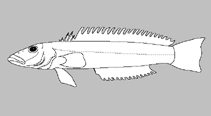 No image available for this species;
drawing shows typical species in Pinguipedidae.
Images Google
drawing shows typical species in Pinguipedidae.
Classification / Noms Noms communs | Synonymes | Catalog of Fishes(Genre, Espèce) | ITIS | CoL | WoRMS | Cloffa
> Perciformes/Uranoscopoidei (Sand dwellers) > Pinguipedidae (Sandperches)
Etymology: Parapercis: Greek, para = the side of + Greek, perke = perch (Ref. 45335); lutevittata: Lute for yellow and vitta for stripe from Latin, in reference to the longitudinal yellow stripe extending from the pectoral fin base to the caudal fin base on the body of this species.
Etymology: Parapercis: Greek, para = the side of + Greek, perke = perch (Ref. 45335); lutevittata: Lute for yellow and vitta for stripe from Latin, in reference to the longitudinal yellow stripe extending from the pectoral fin base to the caudal fin base on the body of this species.
Environnement : milieu / zone climatique / profondeur / gamme de distribution Écologie
marin démersal; profondeur 50 - 100 m (Ref. 86871). Subtropical; 34°N - 33°N, 133°E - 134°E
Distribution Territoires | Zones FAO | Écosystèmes | Occurrences | Carte par point | Introductions | Faunafri
Pacific Ocean: Taiwan, Japan. Known from Tosa Bay, southern Japan, and northern and southern Taiwan. It could be also distributed to Vietnam (Prokofiev, 2008)(Ref. 86871).
Taille / Poids / Âge
Description synthétique Clés d'identification | Morphologie | Morphométrie
Épines dorsales (Total) : 4 - 6; Rayons mous dorsaux (Total) : 23 - 24; Épines anales: 1; Rayons mous anaux: 19 - 21. Greatest body depth 4.6–5.9 in SL; head length 3.5– 3.9 in SL; orbit diameter 3.0–3.9 in head length; fifth dorsal spine longest, 3.0–3.8 in head length; posterior margin of causal fin rounded; pectoral fins 4.2–5.2 in SL; pelvic fins just reaching anus, 4.2–5.6 in SL. Lower jaw project-ing; palatine teeth present; vomerine teeth stout; scales on body, abdomen and cheek ctenoid; margin of opercle with a distinct sharp spine mostly single pore on lower margin of anterior preopercle. With four to five large V-shaped dark-brown transverse bands over the upper side of the body; numerous black dots scattered on and between the V-shaped transverse bands, around pectoral fin, and at pectoral fin base; dorsal fin between the spinous and soft-rayed portion without a prominent notch, membrane between 1–4 spines with prominent black blotch; a dark vertical band below eye; a large deep-brown or black blotch on the pectoral fin base, and a large black spot over the caudal fin base; one irregular diffused longitudinal yellow stripe along the middle body when fresh (Ref. 86871).
Body shape (shape guide): elongated.
Body shape (shape guide): elongated.
Cycle de vie et comportement reproducteur Maturité | Reproduction | Frai | Œufs | Fécondité | Larves
Référence principale
Téléchargez vos références | Références | Coordinateur : Ho, Hsuan-Ching | Collaborateurs
Liao, Y.-C., T.-Y. Cheng and K.-T. Shao, 2011. Parapercis lutevittata, a new cryptic species of Parapercis (Teleostei: Pinguipedidae), from the western Pacific based on morphological evidence and DNA barcoding. Zootaxa 2867:32-42. (Ref. 86871)
CITES
Not Evaluated
Menace pour l'homme
Harmless
Utilisations par l'homme
FAO - Publication: search | FishSource |
Plus d'informations
Écologie trophique
Aliments (proies)
Composition du régime alimentaire
Consommation alimentaire
Rations alimentaires
Prédateurs
Aliments (proies)
Composition du régime alimentaire
Consommation alimentaire
Rations alimentaires
Prédateurs
Dynamique des populations
Paramètres de croissance
Âges / tailles maximales
Longueur-poids rel.
Rel. longueur-longueur.
Fréquences de longueurs
Conversion de masse
Recrutement
Abondance
Paramètres de croissance
Âges / tailles maximales
Longueur-poids rel.
Rel. longueur-longueur.
Fréquences de longueurs
Conversion de masse
Recrutement
Abondance
Cycle de vie
Reproduction
Maturité
Maturité/épines rel.
Fécondité
Frai
Agrégats de frai
Œufs
Développement de l'œuf
Larves
Dynamique des populations larvaires
Reproduction
Maturité
Maturité/épines rel.
Fécondité
Frai
Agrégats de frai
Œufs
Développement de l'œuf
Larves
Dynamique des populations larvaires
Anatomie
Surface branchiale
Cerveau
Otolithe
Surface branchiale
Cerveau
Otolithe
Physiologie
Composition corporelle
Nutriments
Consommation d'oxygène
Type de natation
Vitesse de nage
Pigments visuels
Son de poisson
Maladies et parasites
Toxicité (CL50)
Composition corporelle
Nutriments
Consommation d'oxygène
Type de natation
Vitesse de nage
Pigments visuels
Son de poisson
Maladies et parasites
Toxicité (CL50)
Génétique
génôme
Génétique
Hétérozygotie
Héritabilité
Diversité génétique
génôme
Génétique
Hétérozygotie
Héritabilité
Diversité génétique
Liées à l'homme
Systèmes d'aquaculture
Profils d'aquaculture
Souches
Cas de ciguatera
Timbres, pièces de monnaie, divers
Systèmes d'aquaculture
Profils d'aquaculture
Souches
Cas de ciguatera
Timbres, pièces de monnaie, divers
Outils
E-book | Guide de terrain | Générateur de fréquences de longueur | Outil de dynamique de population | Carte par point |
Capture-MSY |
Articles particuliers
Télécharger en XML
Sources Internet
AFORO (otoliths) | Aquatic Commons | BHL | Cloffa | Websites from users | FishWatcher | CISTI | Catalog of Fishes: Genre, Espèce | DiscoverLife | ECOTOX | FAO - Publication: search | Faunafri | Fishipedia | Fishtrace | GloBI | Google Books | Google Scholar | Google | IGFA World Record | Bases de données nationales | OneZoom | Open Tree of Life | Otolith Atlas of Taiwan Fishes | PubMed | Reef Life Survey | Socotra Atlas | TreeBase | Arbre de Vie | Wikipedia: aller à, chercher | World Records Freshwater Fishing | Zoobank | Zoological Record
Estimations basées sur des modèles
Indice de diversité phylogénétique (Réf. 82804): PD50 = 0.5000 [Uniqueness, from 0.5 = low to 2.0 = high].
Bayesian length-weight: a=0.00692 (0.00314 - 0.01524), b=3.06 (2.88 - 3.24), in cm total length, based on LWR estimates for this Genus-body shape (Ref. 93245).
Niveau trophique (Réf. 69278): 3.5 ±0.4 se; based on size and trophs of closest relatives
Résilience (Réf. 120179): Haut, temps minimum de doublement de population inférieur à 15 mois (Preliminary K or Fecundity.).