This website uses cookies to enhance your browsing experience and ensure the functionality of our site. For more detailed information about the types of cookies we use and how we protect your privacy, please visit our Privacy Information page.
×
Cookie Settings
This website uses different types of cookies to enhance your experience. Please select your preferences below:
> Eupercaria/misc (Various families in series Eupercaria) > Labridae (Wrasses) > Scarinae
Etymology: Cetoscarus:Greek, ketos = a marine monster, whale + Greek, skaros = a fish cited by ancient writers; a parrot fish (Ref. 45335); ocellatus:Name based on the juvenile phase (Ref. 54980). More on author: Valenciennes.
Environnement : milieu / zone climatique / profondeur / gamme de distribution Écologie
marin récifal; profondeur 0 - 30 m (Ref. 90102). Tropical
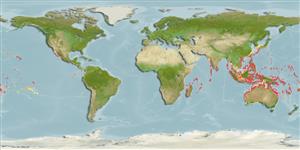
Indo-Pacific: from Somalia to South Africa, eastwards to the Tuamotos including eastern Australia and Middleton Reef; north to southern Japan; south to western Australia.
Longueur à la première maturité / Taille / Poids / Âge
Maturité: Lm30.0 range ? - ? cm Max length : 80.0 cm SL mâle / non sexé; (Ref. 54980)
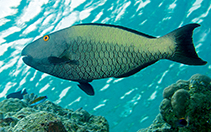
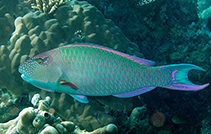
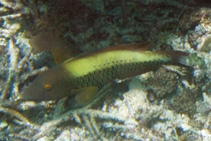
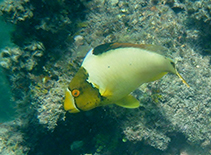
This species is characterized by the following: 14-15 (usually 14) pectoral rays; 5-7 (usually 6) median predorsal scales; 3 rows of scales on cheek, the lower one with 3-7 scales; nodular outer surface of dental plates (vs. smooth on Chlorurus, Hipposcarus and Scarus); conical teeth absent on side of dental plates; lips largely covering dental plates; long snout 1.8-2.2 in HL; juveniles with rounded caudal fin, emarginate in adults. Initial phase with head purplish to reddish brown, finely spotted with black ventrally; body with a broad, pale yellowish zone dorsally, bluish gray below; scales rimmed and spotted with black; median fins brownish red and caudal with a whitish crescent posteriorly. Terminal males green, scales rimmed with pink, head and anterior body with numerous small pink spots except below an orange line from corner of the mouth to pectoral base and across upper abdomen, where solid green with broad, pink, longitudinal ventral band; juveniles white with a broad, dark-edged orange bar covering head except snout and chin, a large, orange-rimmed black spot anteriorly in dorsal fin, and a broad, submarginal orange band in caudal fin (Ref. 54980). Body shape (shape guide): fusiform / normal.
Inhabits seaward reefs and clear lagoons (Ref. 1602), at depths of 1-30 m. Occurs in groups of females with one male (Ref. 90102) form harems; while juveniles are usually solitary (Ref. 9710). Males are territorial. Goes to several changes during growth and very large females change sex to the brightly colored male. Small juveniles usually in dense coral and algae habitats (Ref. 48636). Feeds on benthic algae (Ref. 89972). Minimum depth reported taken from Ref. 128797.
Cycle de vie et comportement reproducteur Maturité | Reproduction | Frai | Œufs | Fécondité | Larves
Oviparous, distinct pairing during breeding (Ref. 205).
Randall, J.E., 2005. Reef and shore fishes of the South Pacific. New Caledonia to Tahiti and the Pitcairn Islands. University of Hawaii Press, Honolulu, Hawaii. 720 p. (Ref. 54980)
Statut dans la liste rouge de l'IUCN (Ref. 130435: Version 2025-2 (Global))
Cycle de vie Reproduction Maturité Maturité/épines rel. Fécondité Frai Agrégats de frai Œufs Développement de l'œuf Larves Dynamique des populations larvaires
Physiologie Composition corporelle Nutriments Consommation d'oxygène Type de natation Vitesse de nage Pigments visuels Son de poisson Maladies et parasites Toxicité (CL50)
Température préférée (Réf. 123201): 24.6 - 29.3, mean 28.2 °C (based on 2269 cells).
Indice de diversité phylogénétique (Réf. 82804): PD50 = 0.7500 [Uniqueness, from 0.5 = low to 2.0 = high].
Bayesian length-weight: a=0.01413 (0.00829 - 0.02406), b=3.03 (2.89 - 3.17), in cm total length, based on LWR estimates for this species & (Sub)family-body (Ref. 93245).
Generation time: 4.3 ( na - na) years. Estimated as median ln(3)/K based on 1 growth studies.
Résilience (Réf. 120179): Milieu, temps minimum de doublement de population : 1,4 à 4,4 années (Preliminary K or Fecundity.).
Vulnérabilité de la pêche (Ref. 59153): High vulnerability (59 of 100). 🛈