This website uses cookies to enhance your browsing experience and ensure the functionality of our site. For more detailed information about the types of cookies we use and how we protect your privacy, please visit our Privacy Information page.
×
Cookie Settings
This website uses different types of cookies to enhance your experience. Please select your preferences below:
> Gobiiformes (Gobies) > Gobiidae (Gobies) > Gobiinae
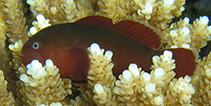
Etymology: Gobiodon:Latin, gobius = gudgeon + Greek, odous = teeth (Ref. 45335); fuscoruber:Named for its uniformly reddish-brown life colouration; name from Latin words 'fuscus' for brown and 'rubrum' for red; typical colouration throughout its distribution despite its geographic colour variants.
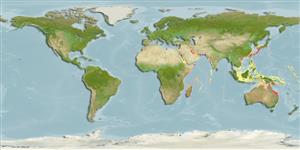
Umwelt: Milieu / Klimazone / Tiefenbereich / Verbreitungsgebiet Ökologie
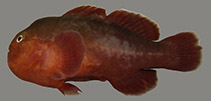
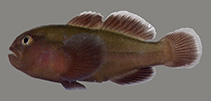
Rückenflossenstacheln (insgesamt) : 7; Rückenflossenweichstrahlen (insgesamt) : 10; Afterflossenstacheln: 1; Afterflossenweichstrahlen: 8; Wirbelzahl: 26. This species is distinguished by the following characters: D Vi+I,0; A I,8; both head and body naked; distinct groove between isthmus and interopercle; deep body (the depth at pelvic-fin origin 40.4-44.3 % SL) and strongly compressed; juveniles with rounded head, large adults with steep profile, slightly hump-headed; caudal peduncle relatively slender (depth 14.8-16.0% SL); colour of juveniles and adults dark reddish brown with greenish subcutaneous gleam on dorsal part of body; median fins plain (western Pacific Oceans) or with pale margin (Red Sea and Indian Ocean); iris plain light blue (Red Sea) or scattered with red-brown dots on the outer margin (Ref. 94082). Body shape (shape guide): short and / or deep; Cross section: compressed.
Facultative air-breathing in the genus (Ref. 126274); Occurs on reef flats, crests and upper reef slopes in less exposed areas; and prefers Acropora selago, but also occurs in a number of other, narrowly branched Acropora species such as A. acuminata and A. hyacinthus (Ref. 94082).
Herler, J., S.V. Bogorodsky and T. Suzuki, 2013. Four new species of coral gobies (Teleostei: Gobiidae: Gobiodon), with comments on their relationships within the genus. Zootaxa 3709(4):301-329. (Ref. 94082)
IUCN Rote Liste Status (Ref. 130435: Version 2025-2 (Global))
Bevorzugte Temperatur (Ref. 123201): 21.8 - 27.7, mean 26.2 °C (based on 807 cells).
Phylogenetischer Diversitätsindex (Ref. 82804): PD50 = 0.5000 [Uniqueness, from 0.5 = low to 2.0 = high].
Bayesian length-weight: a=0.01995 (0.00906 - 0.04395), b=3.01 (2.83 - 3.19), in cm total length, based on all LWR estimates for this body shape (Ref. 93245).
Trophische Ebene (Ref. 69278): 3.4 ±0.4 se; based on size and trophs of closest relatives
Widerstandsfähigkeit (Ref. 120179): hoch, Verdopplung der Population dauert weniger als 15 Monate. (Preliminary K or Fecundity.).
Anfälligkeit der Fischerei (Ref. 59153): Low vulnerability (10 of 100). 🛈