



Brachyhypopomus alberti Crampton, de Santana, Waddell & Lovejoy, 2017
Загрузить свой Фото и Видео
Изображение на Google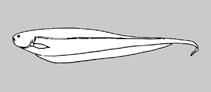 No image available for this species;
drawing shows typical species in Hypopomidae.
Изображение на Google
drawing shows typical species in Hypopomidae.
Классификация / Имена народные названия | синонимы | Catalog of Fishes(род, виды) | ITIS | CoL | WoRMS | Cloffa
> Gymnotiformes (Knifefishes) > Hypopomidae (Bluntnose knifefishes)
Etymology: Brachyhypopomus: Greek, brachys, eia = short + Greek, hypo = under + Greek, poma, -atos = cover (Ref. 45335); alberti: Named for James S. Albert, American (USA) ichthyologist, collector of part of the type series, for his enormous contributions to the systematic biology of gymnotiform fishes.
Eponymy: Dr James Spurling Albert (d: 1964) is a biologist and ichthyologist who is Professor in the Department of Biology (2015) at the University of Louisiana, Lafayette. [...] (Ref. 128868), visit book page.
Etymology: Brachyhypopomus: Greek, brachys, eia = short + Greek, hypo = under + Greek, poma, -atos = cover (Ref. 45335); alberti: Named for James S. Albert, American (USA) ichthyologist, collector of part of the type series, for his enormous contributions to the systematic biology of gymnotiform fishes.
Eponymy: Dr James Spurling Albert (d: 1964) is a biologist and ichthyologist who is Professor in the Department of Biology (2015) at the University of Louisiana, Lafayette. [...] (Ref. 128868), visit book page.
Окружающая среда: среда / климатическая зона / пределы глубины / диапазон распространения экология
; пресноводный донно-пелагический; pH range: 5.2 - 5.5. Tropical; 22°C - 24°C (Ref. 116763)
распространение Территории | регионы FAO | Экосистемы | места находок | карта точек | интродукции | Faunafri
South America: upper rio Madeira basin in Brazil and Bolivia.
Размер / Вес / Возраст
половая зрелость: Lm ? range ? - ? cm
Max length : 11.1 cm TL самец/пол неопределен; (Ref. 116763); 10.0 cm TL (female)
Max length : 11.1 cm TL самец/пол неопределен; (Ref. 116763); 10.0 cm TL (female)
Краткое описание определительные ключи | морфология | морфометрия
членистые (мягкие) лучи анального плавника: 172 - 191. Brachyhypopomus alberti is distinguished from other species of the genus Brachyhypopomus by the following combination of characters: absence of depigmented stripe along middorsal region of body (vs. prominent pale uninterrupted middorsal stripe from occipital region to base of caudal filament in B. arrayae, B. beebei, B. belindae, B. gauderio, B. pinnicaudatus, and B. verdii); 20-22 precaudal vertebrae (vs. 15-19 in B. batesi, B. benjamini, B. bennetti, B. bombilla, B. bullocki, B. cunia, B. diazi, B. hendersoni, B. menezesi, B. provenzanoi, B. regani, and B. sullivani); anal fin with 182-202 rays (vs. 226-293 in B. brevirostris); presence of continuous or discontinuous dark vertical or diagonally oriented bands or saddles on body surface dorsal to lateral line, often extending across lateral line into ventral lateral surface (vs. absence of oblique bands or saddles on body surface dorsal to lateral line in B. draco, B. flavipomus, B. jureiae, and B. palenque); 3 bilateral columns of electrocytes at the anal-fin terminus (vs. 4-5 in B. janeiroensis and B. occidentalis (except some populations in Colombia and Venezuela); absence of dark suborbital stripe (vs. presence in B. walteri). It differs from most but not all specimens of B. hamiltoni by having a higher number of pectoral-fin rays 15-16 (mode 16) (vs. 12-15 (mode 13) (only 2 of 18 measured specimens of B. hamiltoni exhibited an overlapping number of pectoral-fin rays with B. alberti). It can be differentiated from B. hamiltoni by the absence of the first of five branchiostegal rays (vs. presence in B. hamiltoni Mago-Leccia) (Ref. 116763).
Body shape (shape guide): elongated.
Body shape (shape guide): elongated.
Facultative air-breathing in the genus (Ref. 126274); The type series was sampled in tropical forest and savanna near Riberalta, Bolivia from small low-conductivity clearwater and blackwater terra firme streams. Found mostly commonly in marginal root mats, and in emergent or submerged aquatic vegetation. Recorded water parameters at the sampling sites included the following: conductivity 5-15 μS/cm, dissolved oxygen 3.0-5.0 mg/l, temperature 22-24°C, and pH 5.2-5.5. Co-inhabits in geographical sympatry and ecological syntopy with the following species occurring in terra firme stream: B. brevirostris, B. sullivani, and B. walteri. In the region of the type locality, it is allotopic with whitewater floodplain species such as B. arrayae, B. bombilla, and B. pinnicaudatus. It co-occurs in geographical sympatry with its sister species B. arrayae, but the species exhibit a noteworthy difference in ecological distribution. B. alberti occupies the low conductivity (ca. 5-15 μScm-1) terra firme forest and savanna streams, while B. arrayae mainly inhabits higher-conductivity whitewater floodplain systems (ca. 150 μScm-1 at the time of sampling). B. alberti was collected together with B. arrayae (and also B. pinnicaudatus) in the lower reaches of terra firme streams, at the ecotone with the río Beni floodplain (Ref. 116763).
Жизненный цикл и брачное поведение половая зрелость | размножение | нерест | икра | Плодовитость | личинки
Основная ссылка
Загрузите свои рекомендации | ссылки | координатор : Albert, James S. | соавторы
Crampton, W.G.R., C.D. de Santana, J.C. Waddell and N.R. Lovejoy, 2017. A taxonomic revision of the Neotropical electric fish genus Brachyhypopomus (Ostariophysi: Gymnotiformes: Hypopomidae), with descriptions of 15 new species. Neotrop. ichthyol. 14(4):e150146. (Ref. 116763)
CITES
Not Evaluated
Угроза для людей
Harmless
Использование человеком
рыболовство: интереса не представляет
FAO - Publication: search | FishSource |
дополнительная информация
Трофическая экология
Пищевые предметы (добыча)
состав пищи
потребление пищи
Продовольственные пайки
хищники
Пищевые предметы (добыча)
состав пищи
потребление пищи
Продовольственные пайки
хищники
Динамика численности населения
Параметры роста
Макс. возраст / размер
Отношение длины к весу.
Отношение длины к длине.
Размерный состав
Преобразование массы
пополнение
численность
Параметры роста
Макс. возраст / размер
Отношение длины к весу.
Отношение длины к длине.
Размерный состав
Преобразование массы
пополнение
численность
Жизненный цикл
размножение
половая зрелость
Зрелость/Жиры относительно.
Плодовитость
нерест
Нерестовые скопления
икра
Развитие икры
личинки
динамика численности личинок
размножение
половая зрелость
Зрелость/Жиры относительно.
Плодовитость
нерест
Нерестовые скопления
икра
Развитие икры
личинки
динамика численности личинок
Анатомия
жаберная область
Мозг
Отолит
жаберная область
Мозг
Отолит
Физиология
Состав тела
Питательные вещества
Потребление кислорода
Тип плавания
Скорость плавания
Зрительные пигменты
Звук рыбы
Болезни и паразиты
Токсичность (LC50s)
Состав тела
Питательные вещества
Потребление кислорода
Тип плавания
Скорость плавания
Зрительные пигменты
Звук рыбы
Болезни и паразиты
Токсичность (LC50s)
генетика
Геном
генетика
Гетерозиготность
наследуемость
Генетическое разнообразие
Геном
генетика
Гетерозиготность
наследуемость
Генетическое разнообразие
Связанные с человеком
Системы аквакультуры
особенности рыбоводства
степень растяжения
Случаи заболевания сигуатерой
Марки, монеты и прочее.
Системы аквакультуры
особенности рыбоводства
степень растяжения
Случаи заболевания сигуатерой
Марки, монеты и прочее.
инструменты
Специальные отчеты
Проверить содержание в аквариумах | Проверить опубликованные видовые данные | Проверить опубликованные данные по аквакультуре
Скачать в формате XML
ресурсы в Интернет
AFORO (otoliths) | Aquatic Commons | BHL | Cloffa | Websites from users | Проверить FishWatcher | CISTI | Catalog of Fishes: род, виды | DiscoverLife | ECOTOX | FAO - Publication: search | Faunafri | Fishipedia | Fishtrace | GloBI | Google Books | Google Scholar | Google | IGFA World Record | OneZoom | Open Tree of Life | Otolith Atlas of Taiwan Fishes | PubMed | Reef Life Survey | Socotra Atlas | TreeBase | Tree of Life | Wikipedia: Вперёд, поиск | World Records Freshwater Fishing | Zoobank | Зоологическая летопись
Оценки, основанные на моделях
Индекс филогенетического разнообразия (ссылка 82804): PD50 = 0.5000 [Uniqueness, from 0.5 = low to 2.0 = high].
Bayesian length-weight: a=0.00372 (0.00141 - 0.00980), b=3.06 (2.83 - 3.29), in cm total length, based on LWR estimates for this (Sub)family-body shape (Ref. 93245).
Трофический уровень (ссылка 69278): 3.1 ±0.4 se; based on size and trophs of closest relatives