



Distichodus mbiniensis Schmidt, Knobloch & Barrientos, 2021
อัพโหลดของคุณ ภาพถ่าย และ วิดีโอ
Google image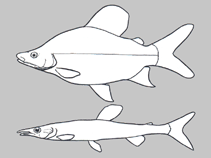 No image available for this species;
drawing shows typical species in Distichodontidae.
Google image
drawing shows typical species in Distichodontidae.
การจำแนกประเภท / ชื่อ ชื่อสามัญ | ชื่อพ้อง | Catalog of Fishes(สกุล, ชนิด) | ITIS | CoL | WoRMS | Cloffa
> Characiformes (Characins) > Distichodontidae (Distichodus)
Etymology: Distichodus: Greek, di = two + Greek, stix, stichos = line, row (Ref. 45335); mbiniensis: The specific epithet refers to the Mbini River which is the Ndowe name for the Rio Wele; the Ndowe are Bantu-speaking people that live along the coastal region in Equatorial Guinea (Ref. 127217).
Etymology: Distichodus: Greek, di = two + Greek, stix, stichos = line, row (Ref. 45335); mbiniensis: The specific epithet refers to the Mbini River which is the Ndowe name for the Rio Wele; the Ndowe are Bantu-speaking people that live along the coastal region in Equatorial Guinea (Ref. 127217).
สิ่งแวดล้อม : สิ่งแวดล้อม / เขตภูมิอากาศ / ระดับความลึก / ระยะการกระจายสินค้า นิเวศวิทยา
; น้ำจืด กลุ่มสัตว์หน้าดิน,กลุ่มสัตว์พื้นท้องน้ำ. Tropical
การแพร่กระจาย อาณาเขต | พื้นที่จำแนกตาม FAO | ระบบนิเวศหลายระบบ | การปรากฏขึ้น,การเกิดขึ้น,พบ | ตำแหน่งบนแผนที่ | การแนะนำ | Faunafri
Africa: upper Mbini River drainage in Equatorial Guinea (Ref. 127217), but may also occur within this drainage in Gabon (Ref. 127217).
ขนาด / น้ำหนัก / อายุ
คำอธิบายสั้นๆ เครื่องมือที่ใช้ในการแยกชนิดสัตว์,สิ่งมีชีวิตออกจากกัน | สัณฐานวิทยา | ความยาวต่างๆ
เงี่ยงครีบหลัง (รวม) : 0; ก้านครีบอ่อนที่หาง (รวม) : 16 - 18; เงี่ยงครีบก้น: 0; ก้านครีบอ่อนที่ก้น: 13 - 14. Diagnosis: Distichodus mbiniensis is readily distinguished from the larger-bodied, higher-scale count Distichodus species (D. antonii, D. atroventralis, D. fasciolatus, D. lusosso, D. mossambicus, D. sexfasciatus, D. langi, D. rostratus, D. engycephalus, D. kasaiensis, D. ingae, D. polli, D. petersii, D. nefasch, D. brevipinnis and D. schenga) in having fewer lateral line scales, 40-42 vs. more than 60, and in achieving a smaller maximum standard length, less than 15 cm vs. more than 30 cm (Ref. 127217). This species is also distinguished from the smaller-bodied, lower-scale count Distichodus species in the following ways: Distichodus mbiniensis is distinguished from D. decemmaculatus and D. teugelsi in having two rows of teeth on the lower jaw vs. one; it can be readily distinguished from D. noboli, D. hypostomatus and D. maculatus in having fewer scales along the lateral line, 40-42 vs. 45, 53-60 and 75 respectively, and distinguished from D. rufigiensis in not having prominent vertical bars along the sides; it is distinguished from D. kolleri in having fewer dorsal-fin rays, 16-18 total vs. 21-26, and distinguished from D. altus and D. affinis in having fewer total anal-fin rays, 13-14 vs. 21-22 (Ref. 127217). Distichodus mbiniensis is distinguished from D. notospilus in having more scales along the lateral line, 41-42, rarely 40, vs. 37-39, rarely 40, a much less prominent elongated dark spot at the base of the caudal fin, a shorter dorsal fin, 21.4-27.2% of standard length vs. 22.7-34.2%, and shallower caudal peduncle, 11.8-13.0% of standard length vs. 12.3-14.1%; it is distinguished from D. microps in having a deeper body, usually seven scales from lateral line to the pelvic fin vs. six, a subterminal mouth vs. the nearly inferior mouth of D. microps, a shallower, 11.8-13.0% of standard length vs. 12.4-14.2%, and shorter caudal peduncle, 9.7-12.6% of standard length vs. 11.9-14.8%, a larger eye, 58.6-88.0% of snout length vs. 56.7-80.4%, a wider subopercle, and a shallower infraorbital 1 with a more curved anterolateral margin vs. a deeper infraorbital 1 with a more rectangular anterolateral margin in D. microps (Ref. 127217).
วงจรชีวิตและพฤติกรรมการผสมพันธุ์ วัยเจริญพันธุ์ | การสืบพันธุ์ | การวางไข่ | เซลสืบพันธ์ของเพศเมีย(ไข่) | ความดกของไข่ | ตัวอ่อน
อ้างอิงหลัก
อัพโหลดข้อมูลอ้างอิงของคุณ | อ้างอิง | ผู้ประสานงาน | ผู้ร่วมมือ
Schmidt, R.C., E.C. Knobloch and C. Barrientos, 2021. Cast netting new species: integrative taxonomy of Distichodus notospilus (Characiformes: Distichodontidae) discovers new species and overlooked areas of endemism in Central Africa. Zootaxa 4952(2):291-313. (Ref. 127217)
สถานะบัญชีแดงของ IUCN (Ref. 130435: Version 2025-2 (Global))
เปราะบาง (VU) (B1ab(iii)); Date assessed: 21 July 2020
CITES
Not Evaluated
ภัยคุกคามต่อมนุษย์
Harmless
การใช้ของมนุษย์
FAO - Publication: search | FishSource |
ข้อมูลเพิ่มเติม
นิเวศวิทยาเขตร้อน
รายการอาหาร (เหยื่อ)
องค์ประอบของอาหาร
การบริโภคอาหาร
การจัดสรรอาหาร
ผู้ล่า
รายการอาหาร (เหยื่อ)
องค์ประอบของอาหาร
การบริโภคอาหาร
การจัดสรรอาหาร
ผู้ล่า
นิเวศวิทยา
นิเวศวิทยา
นิเวศวิทยา
พลวัตของประชากร
พารามิเตอร์การเจริญเติบโต
อายุสูงสุด / ขนาด
ความยาว-น้ำหนักสัมพันธ์
ความยาว-ความยาวสัมพันธ์
ความยาว-ความถี่
การแปลงมวล
การทดแทนที่
อุดมสมบรูณ์
พารามิเตอร์การเจริญเติบโต
อายุสูงสุด / ขนาด
ความยาว-น้ำหนักสัมพันธ์
ความยาว-ความยาวสัมพันธ์
ความยาว-ความถี่
การแปลงมวล
การทดแทนที่
อุดมสมบรูณ์
วงจรชีวิต
การสืบพันธุ์
วัยเจริญพันธุ์
ความสมบูรณ์พันธุ์/เหงือกที่เกี่ยวข้อง
ความดกของไข่
การวางไข่
การรวมตัวของสปอน
เซลสืบพันธ์ของเพศเมีย(ไข่)
การพัฒนาไข่
ตัวอ่อน
พลวัตของสัตว์น้ำวัยอ่อน
การสืบพันธุ์
วัยเจริญพันธุ์
ความสมบูรณ์พันธุ์/เหงือกที่เกี่ยวข้อง
ความดกของไข่
การวางไข่
การรวมตัวของสปอน
เซลสืบพันธ์ของเพศเมีย(ไข่)
การพัฒนาไข่
ตัวอ่อน
พลวัตของสัตว์น้ำวัยอ่อน
การแพร่กระจาย
อาณาเขต
พื้นที่จำแนกตาม FAO
ระบบนิเวศหลายระบบ
การปรากฏขึ้น,การเกิดขึ้น,พบ
การแนะนำ
BRUVS - วิดีโอ
อาณาเขต
พื้นที่จำแนกตาม FAO
ระบบนิเวศหลายระบบ
การปรากฏขึ้น,การเกิดขึ้น,พบ
การแนะนำ
BRUVS - วิดีโอ
กายวิภาคศาสตร์
พื้นที่เหงือก
สมอง
หินโสต
พื้นที่เหงือก
สมอง
หินโสต
สรีรวิทยา
องค์ประกอบของร่างกาย
สารอาหาร
การใช้ออกซิเจน
ประเภทการว่ายน้ำ
ระดับความเร็วในการว่ายน้ำ
เม็ดสีที่มองเห็นได้
เสียงปลา
โรคและปรสิต
ความเป็นพิษ (LC50s)
องค์ประกอบของร่างกาย
สารอาหาร
การใช้ออกซิเจน
ประเภทการว่ายน้ำ
ระดับความเร็วในการว่ายน้ำ
เม็ดสีที่มองเห็นได้
เสียงปลา
โรคและปรสิต
ความเป็นพิษ (LC50s)
พันธุศาสตร์
จีโนม
พันธุศาสตร์
ความไม่สมดุลทางเชื้อชาติ
อัตราพันธุกรรม
ความหลากหลายทางพันธุกรรม
จีโนม
พันธุศาสตร์
ความไม่สมดุลทางเชื้อชาติ
อัตราพันธุกรรม
ความหลากหลายทางพันธุกรรม
เกี่ยวข้องกับมนุษย์
ระบบการเพาะเลี้ยงสัตว์น้ำ
ประวัติการเพาะเลี้ยงสัตว์น้ำ
สายพันธุ์
กรณีซิเกวเทอรา
แสตมป์ เหรียญ อื่นๆ
ระบบการเพาะเลี้ยงสัตว์น้ำ
ประวัติการเพาะเลี้ยงสัตว์น้ำ
สายพันธุ์
กรณีซิเกวเทอรา
แสตมป์ เหรียญ อื่นๆ
เครื่องมือ
หนังสืออิเล็กทรอนิกส์ | คู่มือภาคสนาม | ผู้มีความชำนาญในเรื่องความถี่ของความยาว | เครื่องมือในการศึกษาชีวประวัติ | ตำแหน่งบนแผนที่ |
จับ-MSY |
รายงานพิเศษ
ตรวจสอบการบำรุงรักษาตู้ปลา | ตรวจสอบเอกสารข้อเท็จจริงเกี่ยวกับสายพันธุ์ | ตรวจสอบเอกสารข้อเท็จจริงเกี่ยวกับการเพาะเลี้ยงสัตว์น้ำ
ดาวน์โหลด XML
หน้าสรุป | ข้อมูลสำคัญ | ชื่อสามัญ | ภาพถ่าย
แหล่งที่มาจากอินเตอร์เน็ต
AFORO (otoliths) | Aquatic Commons | BHL | Cloffa | Websites from users | Check FishWatcher | CISTI | Catalog of Fishes: สกุล, ชนิด | DiscoverLife | ECOTOX | FAO - Publication: search | Faunafri | Fishipedia | Fishtrace | GloBI | Google Books | Google Scholar | Google | IGFA World Record | OneZoom | Open Tree of Life | Otolith Atlas of Taiwan Fishes | PubMed | Reef Life Survey | Socotra Atlas | TreeBase | แผนภูมิชีวิตแบบต้นไม้ | Wikipedia: Go, ค้นหา | World Records Freshwater Fishing | Zoobank | บันทึกทางด้านสัตววิทยา