



Glyptothorax giudikyensis Kosygin, Singh & Gurumayum, 2020
Hochladen Photos und videos
Google Bild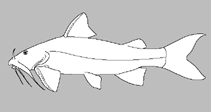 No image available for this species;
drawing shows typical species in Sisoridae.
Google Bild
drawing shows typical species in Sisoridae.
Klassifizierung / Names Namen | Synonyme | Catalog of Fishes(Gattung, Arten) | ITIS | CoL | WoRMS | Cloffa
> Siluriformes (Catfishes) > Sisoridae (Sisorid catfishes) > Sisorinae
Etymology: Glyptothorax: Greek, glyptes = carver + Greek, thorax = breast (Ref. 45335); giudikyensis: Named after its type locality, Giudiky stream.
Etymology: Glyptothorax: Greek, glyptes = carver + Greek, thorax = breast (Ref. 45335); giudikyensis: Named after its type locality, Giudiky stream.
Umwelt: Milieu / Klimazone / Tiefenbereich / Verbreitungsgebiet Ökologie
; süßwasser benthopelagisch; tiefenbereich 0 - 1 m (Ref. 130785). Tropical
Verbreitung Territorien | FAO Gebiete | Ökosysteme | Vorkommen | Punkt Karte | Einführungen | Faunafri
Asia: India.
Größe / Gewicht / Alter
Kurzbeschreibung Bestimmungsschlüssel | Morphologie | Morphometrie
This species is distinguished from its congeners from the Barak-Meghna-Surma River drainage and neighbouring drainages except G. scrobiculus in having (vs. lacking) a furrow
running along the entire length of the ventral surface of the pectoral spine; differs further
from its congeners, including G. scrobiculus, in having an elongated body (depth at dorsal-fin origin 12.4-14.8 % SL, at anus 10.5-12.7 % SL); head length 23.5-24.3 % SL; thoracic adhesive apparatus chevron-shaped, with a V-shaped median depression, its length 8.1-13.3 % SL; dorsal-fin spine serrated posteriorly, its length 9.1-11.6 % SL; predorsal length 32.8-33.6 % SL; caudal peduncle length 20.0-22.9 % SL, its depth 7.6-8.0 % SL; nasal barbel does not reach the anterior margin of eye; two longitudinal faint pale cream narrow stripes on the body, along mid-dorsal line and lateral line; skin tuberculated; with numerous tubercles on the pectoral and pelvic-fin rays; vertebrae 22 + 18 or 23 + 20 vertebrae (Ref. 130785).
Cross section: oval.
Cross section: oval.
This species was found is a small hill stream draining moderately dense forest. Inhabits relatively swift but clear and shallow (50-100 cm) water where the bottom of the river is visible.There are different types of substrates in the area, including medium to large-sized boulders, gravels, and cobbles with thick layers of aquatic green algae and mosses. Vegetation along the stream bank is characteristic of tropical evergreen forest dominated by different types of bamboos, orchids, banana plants and different types of trees. Associated fish recorded from the type locality includes species of Channa, Garra, Neolissochilus, Puntius and Schistura (Ref. 130785).
Lebenszyklus und Paarungsverhalten Geschlechtsreife | Fortpflanzung | Ablaichen | Eier | Fruchtbarkeit | Larven
Hauptreferenz
Laden Sie Ihre Referenzen hoch | Referenzen | Koordinator | Partner
Kosygin, L., P. Singh and S.D. Gurumayum, 2020. Glyptothorax giudikyensis, a new species of catfish (Teleostei: Sisoridae) from Manipur, India. Ichthyol. Explor. Freshwat. 30(2):141-150. [First published online, pp. 1-10, 26 June 2020. Volume, issue and pages added 10 Sept. 2020.] (Ref. 130785)
CITES
Not Evaluated
Bedrohung für Menschen
Harmless
Nutzung durch Menschen
Fischereien: nicht kommerziell
FAO - Publication: search | FishSource |
Mehr Information
Trophische Ökologie
Lebensmittel (Beutetiere)
Nahrungszusammensetzung
Nahrungsaufnahme
Lebensmittelrationen
Räuber
Lebensmittel (Beutetiere)
Nahrungszusammensetzung
Nahrungsaufnahme
Lebensmittelrationen
Räuber
Populationsdynamik
Wachstumsparameter
Max. Alter/Größen
Länge-Gewicht-Rel.
Länge-Länge-Verhältnis.
Längenhäufigkeiten
Massenkonvertierung
Rekrutierung
Dichte
Wachstumsparameter
Max. Alter/Größen
Länge-Gewicht-Rel.
Länge-Länge-Verhältnis.
Längenhäufigkeiten
Massenkonvertierung
Rekrutierung
Dichte
Lebenszyklus
Fortpflanzung
Geschlechtsreife
Reifung/Kiemen rel.
Fruchtbarkeit
Ablaichen
Laichaggregationen
Eier
Eientwicklung
Larven
Larven Pop.Dyn.
Fortpflanzung
Geschlechtsreife
Reifung/Kiemen rel.
Fruchtbarkeit
Ablaichen
Laichaggregationen
Eier
Eientwicklung
Larven
Larven Pop.Dyn.
Anatomie
Kiemenoberfläche
Gehirn
Otolith
Kiemenoberfläche
Gehirn
Otolith
Physiologie
Körperliche Zusammensetzung
Nährstoffe
Sauerstoffverbrauch
Schwimmart
Schwimmgeschwindigkeit
Visuelle Pigmente
Fischgeräusche
Krankheiten und Parasiten
Toxizität (LC50s)
Körperliche Zusammensetzung
Nährstoffe
Sauerstoffverbrauch
Schwimmart
Schwimmgeschwindigkeit
Visuelle Pigmente
Fischgeräusche
Krankheiten und Parasiten
Toxizität (LC50s)
Genetik
Genom
Genetik
Heterozygotie
Vererbbarkeit
Genetische Vielfalt
Genom
Genetik
Heterozygotie
Vererbbarkeit
Genetische Vielfalt
Menschenbezogen
Aquakultur-Systeme
Aquakultur Profile
Zuchtlinien
Ciguatera-Fälle
Briefmarken, Münzen, Verschiedenes.
Aquakultur-Systeme
Aquakultur Profile
Zuchtlinien
Ciguatera-Fälle
Briefmarken, Münzen, Verschiedenes.
Tools
Zusatzinformationen
Download XML
Zusammenfassung | Punktdaten | Namen | Photos
Internet Quellen
AFORO (otoliths) | Aquatic Commons | BHL | Cloffa | Websites from users | FishWatcher Einträge suchen | CISTI | Catalog of Fishes: Gattung, Arten | DiscoverLife | ECOTOX | FAO - Publication: search | Faunafri | Fishipedia | Fishtrace | GloBI | Google Books | Google Scholar | Google | IGFA World Record | OneZoom | Open Tree of Life | Otolith Atlas of Taiwan Fishes | PubMed | Reef Life Survey | Socotra Atlas | TreeBase | Tree of Life | Wikipedia: Gehe zu, Suchen | World Records Freshwater Fishing | Zoobank | Zoologischer Rekord
Schätzungen auf der Grundlage von Modellen
Phylogenetischer Diversitätsindex (Ref. 82804): PD50 = 0.5000 [Uniqueness, from 0.5 = low to 2.0 = high].
Bayesian length-weight: a=0.00794 (0.00365 - 0.01726), b=3.02 (2.85 - 3.19), in cm total length, based on LWR estimates for this Genus-body shape (Ref. 93245).
Trophische Ebene (Ref. 69278): 3.2 ±0.4 se; based on size and trophs of closest relatives
Widerstandsfähigkeit (Ref. 120179): mittel, Verdopplung der Population dauert 1,4 - 4,4 Jahre. (Preliminary K or Fecundity.).