



Envoyez vos Photos et vidéos
Images Google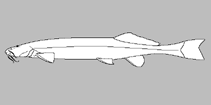 No image available for this species;
drawing shows typical species in Trichomycteridae.
Images Google
drawing shows typical species in Trichomycteridae.
Classification / Noms Noms communs | Synonymes | Catalog of Fishes(Genre, Espèce) | ITIS | CoL | WoRMS | Cloffa
> Siluriformes (Catfishes) > Trichomycteridae (Pencil or parasitic catfishes) > Tridentinae
Etymology: Tridens: Greek, tres tria = three + Latin, dens = teeth (Ref. 45335); vitreus: Name vitreus from the Latin word 'viteus', meaning 'glossy, translucent', in reference to the transparency of the head and body in life.
Etymology: Tridens: Greek, tres tria = three + Latin, dens = teeth (Ref. 45335); vitreus: Name vitreus from the Latin word 'viteus', meaning 'glossy, translucent', in reference to the transparency of the head and body in life.
Environnement : milieu / zone climatique / profondeur / gamme de distribution Écologie
; eau douce démersal. Tropical
Distribution Territoires | Zones FAO | Écosystèmes | Occurrences | Carte par point | Introductions | Faunafri
South America: Brazil.
Taille / Poids / Âge
Description synthétique Clés d'identification | Morphologie | Morphométrie
Rayons mous dorsaux (Total) : 14; Rayons mous anaux: 21; Vertèbres: 48 - 49. This species is distinguished by the following set of characters: pelvic fin and girdle absent; 48 or 49 vertebrae and a total of 14 dorsal-fin rays; emarginate caudal fin; anal and the urogenital openings situated at a vertical through the centrum of the 25th vertebra; anal-fin origin at a vertical through the centrum of the 27th or 28th vertebrae; the mesehtmoid axis completely over its cornu; a shorter maxillary barbel, its tip reaching the first anterior 25% of the orbit length; premaxillary teeth 81-82; dorsal-fin rays 14; anal-fin rays 21; lateral-line pores 2; a slender frontal, its anterior half approximately two times wider than its posterior half width; a cartilaginous maxilla; a robust maxilla; a narrow joint between quadrate and hyomandibula; posterodorsal process of the hyomandibula 5% of the hyomandibula length; slender opercular patch of odontodes; interopercular odontodes 5; the upper hypural plate cartilage occupying about 25% of its length; the presence of a proximal, distal and ventral cartilages on the ventral hypohyal; 4 lateral process on the basibranchial present; cartilage block on the lateral process of the autopalatine absent; well developed ossification on the proximal margin of the ventral hypohyal absent; hypobranchial foramen absent; and anterior joint between the quadrate and base of the posterodorsal process of the hyomandibula absent (Ref. 137638).
Body shape (shape guide): elongated; Cross section: oval.
Body shape (shape guide): elongated; Cross section: oval.
This species inhabits small white water stream with slow current and substrate predominantly composed of sand (Ref. 137638).
Cycle de vie et comportement reproducteur Maturité | Reproduction | Frai | Œufs | Fécondité | Larves
Référence principale
Téléchargez vos références | Références | Coordinateur : Pinna, Mário de | Collaborateurs
Henschel, E., W.M. Ohara and W.J.E.M. Costa, 2023. Two newminiature translucent catfish species of the rare genus Tridens (Siluriformes: Trichomycteridae) from the Madeira River basin, northern Brazil. J Fish Biol. 103:155-171. (Ref. 137638)
CITES
Not Evaluated
Menace pour l'homme
Harmless
Utilisations par l'homme
Pêcheries: sans intérêt
FAO - Publication: search | FishSource |
Plus d'informations
Écologie trophique
Aliments (proies)
Composition du régime alimentaire
Consommation alimentaire
Rations alimentaires
Prédateurs
Aliments (proies)
Composition du régime alimentaire
Consommation alimentaire
Rations alimentaires
Prédateurs
Dynamique des populations
Paramètres de croissance
Âges / tailles maximales
Longueur-poids rel.
Rel. longueur-longueur.
Fréquences de longueurs
Conversion de masse
Recrutement
Abondance
Paramètres de croissance
Âges / tailles maximales
Longueur-poids rel.
Rel. longueur-longueur.
Fréquences de longueurs
Conversion de masse
Recrutement
Abondance
Cycle de vie
Reproduction
Maturité
Maturité/épines rel.
Fécondité
Frai
Agrégats de frai
Œufs
Développement de l'œuf
Larves
Dynamique des populations larvaires
Reproduction
Maturité
Maturité/épines rel.
Fécondité
Frai
Agrégats de frai
Œufs
Développement de l'œuf
Larves
Dynamique des populations larvaires
Anatomie
Surface branchiale
Cerveau
Otolithe
Surface branchiale
Cerveau
Otolithe
Physiologie
Composition corporelle
Nutriments
Consommation d'oxygène
Type de natation
Vitesse de nage
Pigments visuels
Son de poisson
Maladies et parasites
Toxicité (CL50)
Composition corporelle
Nutriments
Consommation d'oxygène
Type de natation
Vitesse de nage
Pigments visuels
Son de poisson
Maladies et parasites
Toxicité (CL50)
Génétique
génôme
Génétique
Hétérozygotie
Héritabilité
Diversité génétique
génôme
Génétique
Hétérozygotie
Héritabilité
Diversité génétique
Liées à l'homme
Systèmes d'aquaculture
Profils d'aquaculture
Souches
Cas de ciguatera
Timbres, pièces de monnaie, divers
Systèmes d'aquaculture
Profils d'aquaculture
Souches
Cas de ciguatera
Timbres, pièces de monnaie, divers
Outils
E-book | Guide de terrain | Générateur de fréquences de longueur | Outil de dynamique de population | Carte par point |
Capture-MSY |
Articles particuliers
Télécharger en XML
Sources Internet
AFORO (otoliths) | Aquatic Commons | BHL | Cloffa | Websites from users | FishWatcher | CISTI | Catalog of Fishes: Genre, Espèce | DiscoverLife | ECOTOX | FAO - Publication: search | Faunafri | Fishipedia | Fishtrace | GloBI | Google Books | Google Scholar | Google | IGFA World Record | OneZoom | Open Tree of Life | Otolith Atlas of Taiwan Fishes | PubMed | Reef Life Survey | Socotra Atlas | TreeBase | Arbre de Vie | Wikipedia: aller à, chercher | World Records Freshwater Fishing | Zoobank | Zoological Record
Estimations basées sur des modèles
Indice de diversité phylogénétique (Réf. 82804): PD50 = 0.6250 [Uniqueness, from 0.5 = low to 2.0 = high].
Bayesian length-weight: a=0.00389 (0.00180 - 0.00842), b=3.12 (2.94 - 3.30), in cm total length, based on all LWR estimates for this body shape (Ref. 93245).
Niveau trophique (Réf. 69278): 3.0 ±0.3 se; based on size and trophs of closest relatives