



Apristurus stenseni (Springer, 1979)
Panama ghost catshark
Envoyez vos Photos et vidéos
Images | Images Google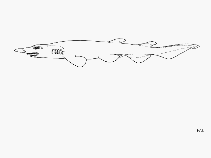 Apristurus stenseni
Photo de FAO
Images | Images Google
Photo de FAO
Classification / Noms Noms communs | Synonymes | Catalog of Fishes(Genre, Espèce) | ITIS | CoL | WoRMS | Cloffa
Élasmobranches (requins et raies) (sharks and rays) > Carcharhiniformes (Ground sharks) > Pentanchidae (Deepwater catsharks)
Etymology: Apristurus: a-, Latin privative, i.e., without; pristis, from pristes (Gr.), sawyer (but here meaning saw); oura (Gr.), tail, referring to absence of saw-toothed crest of enlarged dermal denticles along upper edge of caudal fin as found in the closely related Pristiurus (=Galeus) (See ETYFish); stenseni: In honor of Danish geologist and anatomist Niels Stensen (1638-1686, also known as Nicolas Steno), for “important studies of elasmobranch anatomy, which, because of their scientific accuracy, were influential in the beginnings of elasmobranch systematics in the pre-Linnaean period and later, even to the time of the appearance of Müller and Henle’s ‘Plagiostomia’ in 1841” (See ETYFish).
Eponymy: Dr Neils Stensen (variously rendered Nicolas Steno, Nicolaus Stenonis or Nicolaus Stenonius) (1638–1686) was a Danish geologist, anatomist and author. [...] (Ref. 128868), visit book page.
Etymology: Apristurus: a-, Latin privative, i.e., without; pristis, from pristes (Gr.), sawyer (but here meaning saw); oura (Gr.), tail, referring to absence of saw-toothed crest of enlarged dermal denticles along upper edge of caudal fin as found in the closely related Pristiurus (=Galeus) (See ETYFish); stenseni: In honor of Danish geologist and anatomist Niels Stensen (1638-1686, also known as Nicolas Steno), for “important studies of elasmobranch anatomy, which, because of their scientific accuracy, were influential in the beginnings of elasmobranch systematics in the pre-Linnaean period and later, even to the time of the appearance of Müller and Henle’s ‘Plagiostomia’ in 1841” (See ETYFish).
Eponymy: Dr Neils Stensen (variously rendered Nicolas Steno, Nicolaus Stenonis or Nicolaus Stenonius) (1638–1686) was a Danish geologist, anatomist and author. [...] (Ref. 128868), visit book page.
Environnement : milieu / zone climatique / profondeur / gamme de distribution Écologie
marin bathydémersal; profondeur 915 - 975 m. Deep-water; 9°N - 2°N
Distribution Territoires | Zones FAO | Écosystèmes | Occurrences | Carte par point | Introductions | Faunafri
Taille / Poids / Âge
Maturité: Lm ? range ? - ? cm
Poorly known. Maximum length might be over 23 cm TL. Oviparous (Ref. 50449).
Cycle de vie et comportement reproducteur Maturité | Reproduction | Frai | Œufs | Fécondité | Larves
Oviparous, paired eggs are laid. Embryos feed solely on yolk (Ref. 50449).
Référence principale
Téléchargez vos références | Références | Coordinateur | Collaborateurs
Compagno, L.J.V., 1984. FAO Species Catalogue. Vol. 4. Sharks of the world. An annotated and illustrated catalogue of shark species known to date. Part 2 - Carcharhiniformes. FAO Fish. Synop. 125(4/2):251-655. Rome: FAO. (Ref. 244)
Statut dans la liste rouge de l'IUCN (Ref. 130435: Version 2025-2 (Global))
Préoccupation mineure (LC) ; Date assessed: 07 February 2019
CITES
Not Evaluated
Menace pour l'homme
Harmless
Utilisations par l'homme
Pêcheries: sans intérêt
FAO - Publication: search | FishSource |
Plus d'informations
Écologie trophique
Aliments (proies)
Composition du régime alimentaire
Consommation alimentaire
Rations alimentaires
Prédateurs
Aliments (proies)
Composition du régime alimentaire
Consommation alimentaire
Rations alimentaires
Prédateurs
Écologie
Écologie
Écologie
Dynamique des populations
Paramètres de croissance
Âges / tailles maximales
Longueur-poids rel.
Rel. longueur-longueur.
Fréquences de longueurs
Conversion de masse
Recrutement
Abondance
Paramètres de croissance
Âges / tailles maximales
Longueur-poids rel.
Rel. longueur-longueur.
Fréquences de longueurs
Conversion de masse
Recrutement
Abondance
Cycle de vie
Reproduction
Maturité
Maturité/épines rel.
Fécondité
Frai
Agrégats de frai
Œufs
Développement de l'œuf
Larves
Dynamique des populations larvaires
Reproduction
Maturité
Maturité/épines rel.
Fécondité
Frai
Agrégats de frai
Œufs
Développement de l'œuf
Larves
Dynamique des populations larvaires
Anatomie
Surface branchiale
Cerveau
Otolithe
Surface branchiale
Cerveau
Otolithe
Physiologie
Composition corporelle
Nutriments
Consommation d'oxygène
Type de natation
Vitesse de nage
Pigments visuels
Son de poisson
Maladies et parasites
Toxicité (CL50)
Composition corporelle
Nutriments
Consommation d'oxygène
Type de natation
Vitesse de nage
Pigments visuels
Son de poisson
Maladies et parasites
Toxicité (CL50)
Génétique
génôme
Génétique
Hétérozygotie
Héritabilité
Diversité génétique
génôme
Génétique
Hétérozygotie
Héritabilité
Diversité génétique
Liées à l'homme
Systèmes d'aquaculture
Profils d'aquaculture
Souches
Cas de ciguatera
Timbres, pièces de monnaie, divers
Systèmes d'aquaculture
Profils d'aquaculture
Souches
Cas de ciguatera
Timbres, pièces de monnaie, divers
Outils
E-book | Guide de terrain | Générateur de fréquences de longueur | Outil de dynamique de population | Carte par point |
Capture-MSY |
Articles particuliers
Télécharger en XML
Sources Internet
AFORO (otoliths) | Aquatic Commons | BHL | Cloffa | Websites from users | FishWatcher | CISTI | Catalog of Fishes: Genre, Espèce | DiscoverLife | ECOTOX | FAO - Publication: search | Faunafri | Fishipedia | Fishtrace | GloBI | Google Books | Google Scholar | Google | IGFA World Record | OneZoom | Open Tree of Life | Otolith Atlas of Taiwan Fishes | PubMed | Reef Life Survey | Socotra Atlas | TreeBase | Arbre de Vie | Wikipedia: aller à, chercher | World Records Freshwater Fishing | Zoological Record
Estimations basées sur des modèles
Indice de diversité phylogénétique (Réf. 82804): PD50 = 0.5000 [Uniqueness, from 0.5 = low to 2.0 = high].
Bayesian length-weight: a=0.00347 (0.00172 - 0.00698), b=3.08 (2.90 - 3.26), in cm total length, based on LWR estimates for this (Sub)family-body shape (Ref. 93245).
Niveau trophique (Réf. 69278): 4.0 ±0.6 se; based on size and trophs of closest relatives
Résilience (Réf. 120179): Très faible, temps minimum de doublement de population supérieur à 14 ans (Fec assumed to be <10).