This website uses cookies to enhance your browsing experience and ensure the functionality of our site. For more detailed information about the types of cookies we use and how we protect your privacy, please visit our Privacy Information page.
×
Cookie Settings
This website uses different types of cookies to enhance your experience. Please select your preferences below:
> Eupercaria/misc (Various families in series Eupercaria) > Labridae (Wrasses) > Scarinae
Etymology: Hipposcarus:Greek, ippos = horse + Latin, scarus = a fish cited by ancient writers; 1601 (Ref. 45335).
Environnement : milieu / zone climatique / profondeur / gamme de distribution Écologie
marin récifal; non migrateur; profondeur 1 - 25 m (Ref. 9710). Tropical
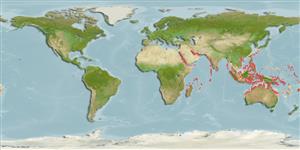
Western Indian Ocean: Red Sea south to Mozambique Channel, including Madagascar and Seychelles and east to Sri Lanka, Maldives and the Chagos Archipelago. Occurrence in Java, Indonesia as reported by Ref. 9710 needs verification.
Taille / Poids / Âge
Maturité: Lm? range ? - ? cm Max length : 75.0 cm TL mâle / non sexé; (Ref. 5490); common length : 35.0 cm TL mâle / non sexé; (Ref. 5450); poids max. publié: 2.3 kg (Ref. 3488)
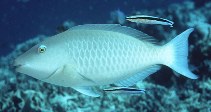
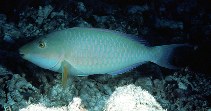
Inhabits coastal regions associated with coral reefs and reef flats. Forms groups consisting of a terminal phased individual and numerous individuals in the initial phase (Ref. 9710). Feeds on benthic algae (Ref. 30573). Caught with nets and other artisanal gear. Mainly sold fresh.
Cycle de vie et comportement reproducteur Maturité | Reproduction | Frai | Œufs | Fécondité | Larves
Oviparous, distinct pairing during breeding (Ref. 205).
Bruce, R.W. and J.E. Randall, 1984. Scaridae. In W. Fischer and G. Bianchi (eds.) FAO species identification sheets for fishery purposes. (Western Indian Ocean fishing area 51). volume 3. [var. pag.] FAO, Rome. (Ref. 3488)
Statut dans la liste rouge de l'IUCN (Ref. 130435: Version 2025-2 (Global))
Cycle de vie Reproduction Maturité Maturité/épines rel. Fécondité Frai Agrégats de frai Œufs Développement de l'œuf Larves Dynamique des populations larvaires
Physiologie Composition corporelle Nutriments Consommation d'oxygène Type de natation Vitesse de nage Pigments visuels Son de poisson Maladies et parasites Toxicité (CL50)
Température préférée (Réf. 123201): 25.2 - 29.3, mean 28.5 °C (based on 3110 cells).
Indice de diversité phylogénétique (Réf. 82804): PD50 = 0.7500 [Uniqueness, from 0.5 = low to 2.0 = high].
Bayesian length-weight: a=0.01349 (0.00901 - 0.02020), b=2.98 (2.86 - 3.10), in cm total length, based on LWR estimates for this species & (Sub)family-body (Ref. 93245).
Niveau trophique (Réf. 69278): 2.0 ±0.00 se; based on food items.
Generation time: 6.5 ( na - na) years. Estimated as median ln(3)/K based on 2 growth studies.
Résilience (Réf. 120179): Faible, temps minimum de doublement de population : 4,5 à 14 années (Preliminary K or Fecundity.).
Vulnérabilité de la pêche (Ref. 59153): Moderate to high vulnerability (51 of 100). 🛈