This website uses cookies to enhance your browsing experience and ensure the functionality of our site. For more detailed information about the types of cookies we use and how we protect your privacy, please visit our Privacy Information page.
×
Cookie Settings
This website uses different types of cookies to enhance your experience. Please select your preferences below:
Elasmobranchii (Haie und Rochen) (sharks and rays) > Carcharhiniformes (Ground sharks) > Scyliorhinidae (Cat sharks) > Scyliorhininae
Etymology: Cephaloscyllium:cephalus, from kephale (Gr.), head, referring to its very broad and depressed head; skylion, Greek for dogfish or small shark (See ETYFish); fasciatum:Latin for banded, referring to variegated color pattern of open saddles and circles with connecting dark lines (See ETYFish).
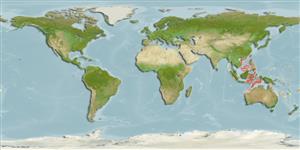
Umwelt: Milieu / Klimazone / Tiefenbereich / Verbreitungsgebiet Ökologie
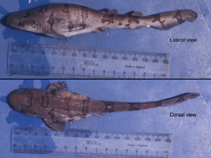
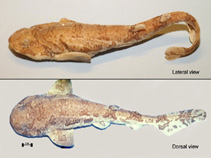
This species is distinguished by the following characters: dorsal sides of body and fins with complex reticulations, with eight open-centered dark brown saddles on body, the first saddle immediately behind eye, second one above gill openings, the third above inner margin of pectoral fin, fourth saddle above middle between pectoral and pelvic finsl dorsal sides of pectoral and pelvic fins with a loop pattern (Ref. 94801). Cross section: angular.
Found in fairly deep water on or near the bottom on the outer continental shelf and uppermost slope (Ref. 244). Minimum depth from Ref. 58018. Can expand itself with air or water (Ref. 244). Oviparous (Ref. 50449). Size at sexual maturity according to literature and specimens studied, for males 36.0 cm and for females less than 42.1 cm with maximum size at least 421 cm TL (Ref. 80388).
Compagno, L.J.V., 1984. FAO Species Catalogue. Vol. 4. Sharks of the world. An annotated and illustrated catalogue of shark species known to date. Part 2 - Carcharhiniformes. FAO Fish. Synop. 125(4/2):251-655. Rome: FAO. (Ref. 244)
IUCN Rote Liste Status (Ref. 130435: Version 2025-2 (Global))
Bevorzugte Temperatur (Ref. 123201): 10.7 - 13.9, mean 12.3 °C (based on 63 cells).
Phylogenetischer Diversitätsindex (Ref. 82804): PD50 = 0.5000 [Uniqueness, from 0.5 = low to 2.0 = high].
Bayesian length-weight: a=0.00269 (0.00140 - 0.00518), b=3.21 (3.04 - 3.38), in cm total length, based on LWR estimates for this (Sub)family-body shape (Ref. 93245).
Trophische Ebene (Ref. 69278): 4.0 ±0.5 se; based on size and trophs of closest relatives
Widerstandsfähigkeit (Ref. 120179): niedrig, Verdopplung der Population dauert 4,5 - 14 Jahre. (Fec assumed to be <100).
Anfälligkeit der Fischerei (Ref. 59153): Low to moderate vulnerability (32 of 100). 🛈