



Malacoraja spinacidermis (Barnard, 1923)
Soft skate
Ajouter votre observation dans Fish Watcher
| Native range | All suitable habitat | Point map | Year 2050 |

|
| This map was computer-generated and has not yet been reviewed. |
| Malacoraja spinacidermis AquaMaps Data sources: GBIF OBIS |
Envoyez vos Photos et vidéos
Images Google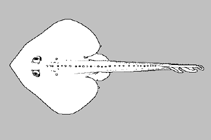 No image available for this species;
drawing shows typical species in Rajidae.
Images Google
drawing shows typical species in Rajidae.
Classification / Noms Noms communs | Synonymes | Catalog of Fishes(Genre, Espèce) | ITIS | CoL | WoRMS | Cloffa
Élasmobranches (requins et raies) (sharks and rays) > Rajiformes (Skates and rays) > Rajidae (Skates)
Etymology: Malacoraja: Greek, malakos = soft + Latin, raja, -ae = ray, fis (Raja sp.) (Ref. 45335).
More on author: Barnard.
Etymology: Malacoraja: Greek, malakos = soft + Latin, raja, -ae = ray, fis (Raja sp.) (Ref. 45335).
More on author: Barnard.
Environnement : milieu / zone climatique / profondeur / gamme de distribution Écologie
marin bathydémersal; profondeur 450 - 1570 m (Ref. 117245). Deep-water; 3°C - 5°C (Ref. 117245); 67°N - 38°S, 72°W - 25°E
Distribution Territoires | Zones FAO | Écosystèmes | Occurrences | Carte par point | Introductions | Faunafri
Eastern Atlantic: Baffin Bay-Davis Strait Offshore to Iceland-Faeroe Ridge, off northwest Africa (Rio de Oro), off southern Namibia and South Africa.
Taille / Poids / Âge
Description synthétique Clés d'identification | Morphologie | Morphométrie
Very broad, almost pentagonal disc, light above and abruptly dark below; snout bluntly pointed with a flexible tip, eyes small and close together, and a disc with broadly rounded rear margins and tips (Ref. 5578). Small juveniles with and adults without thorns and covered only with small denticles (Ref. 5578). Slate-grey or greyish-brown above except rear margins of pectoral and pelvic fins and claspers of adult males which are dark brown; dark brown below, sometimes with light blotches (Ref. 5578). Lack of large thorns on its disc posterior to the scapular region (Ref. 6902).
Body shape (shape guide): other.
Body shape (shape guide): other.
A very rare species inhabiting continental slopes and probably down to the abyssal plains (Ref. 3167). Benthic (Ref. 58426). Adults usually at depths greater than 1,500 m while juveniles are mainly taken from about 450 m downward (Ref. 4426). Minimum depth reported taken from Ref. 4426. Feeds on crustaceans (Ref. 58426). Oviparous (Ref. 50449). Eggs have horn-like projections on the shell (Ref. 205). This species is occasionally captured as by-catch (Ref. 117245).
Cycle de vie et comportement reproducteur Maturité | Reproduction | Frai | Œufs | Fécondité | Larves
Référence principale
Téléchargez vos références | Références | Coordinateur : McEachran, John | Collaborateurs
McEachran, J.D. and K.A. Dunn, 1998. Phylogenetic analysis of skates, a morphologically conservative clade of elasmobranchs (Chondrichthyes: Rajidae). Copeia 1998(2):271-290. (Ref. 27314)
Statut dans la liste rouge de l'IUCN (Ref. 130435: Version 2025-2 (Global))
Préoccupation mineure (LC) ; Date assessed: 20 June 2019
CITES
Not Evaluated
Menace pour l'homme
Harmless
Utilisations par l'homme
Pêcheries: sans intérêt
FAO - Publication: search | FishSource |
Plus d'informations
Écologie trophique
Aliments (proies)
Composition du régime alimentaire
Consommation alimentaire
Rations alimentaires
Prédateurs
Aliments (proies)
Composition du régime alimentaire
Consommation alimentaire
Rations alimentaires
Prédateurs
Dynamique des populations
Paramètres de croissance
Âges / tailles maximales
Longueur-poids rel.
Rel. longueur-longueur.
Fréquences de longueurs
Conversion de masse
Recrutement
Abondance
Paramètres de croissance
Âges / tailles maximales
Longueur-poids rel.
Rel. longueur-longueur.
Fréquences de longueurs
Conversion de masse
Recrutement
Abondance
Cycle de vie
Reproduction
Maturité
Maturité/épines rel.
Fécondité
Frai
Agrégats de frai
Œufs
Développement de l'œuf
Larves
Dynamique des populations larvaires
Reproduction
Maturité
Maturité/épines rel.
Fécondité
Frai
Agrégats de frai
Œufs
Développement de l'œuf
Larves
Dynamique des populations larvaires
Anatomie
Surface branchiale
Cerveau
Otolithe
Surface branchiale
Cerveau
Otolithe
Physiologie
Composition corporelle
Nutriments
Consommation d'oxygène
Type de natation
Vitesse de nage
Pigments visuels
Son de poisson
Maladies et parasites
Toxicité (CL50)
Composition corporelle
Nutriments
Consommation d'oxygène
Type de natation
Vitesse de nage
Pigments visuels
Son de poisson
Maladies et parasites
Toxicité (CL50)
Génétique
génôme
Génétique
Hétérozygotie
Héritabilité
Diversité génétique
génôme
Génétique
Hétérozygotie
Héritabilité
Diversité génétique
Liées à l'homme
Systèmes d'aquaculture
Profils d'aquaculture
Souches
Cas de ciguatera
Timbres, pièces de monnaie, divers
Systèmes d'aquaculture
Profils d'aquaculture
Souches
Cas de ciguatera
Timbres, pièces de monnaie, divers
Outils
E-book | Guide de terrain | Générateur de fréquences de longueur | Outil de dynamique de population | Carte par point |
Capture-MSY |
Articles particuliers
Télécharger en XML
Sources Internet
AFORO (otoliths) | Aquatic Commons | BHL | Cloffa | Websites from users | FishWatcher | CISTI | Catalog of Fishes: Genre, Espèce | DiscoverLife | ECOTOX | FAO - Publication: search | Faunafri | Fishipedia | Fishtrace | GloBI | Google Books | Google Scholar | Google | IGFA World Record | OneZoom | Open Tree of Life | Otolith Atlas of Taiwan Fishes | PubMed | Reef Life Survey | Socotra Atlas | TreeBase | Arbre de Vie | Wikipedia: aller à, chercher | World Records Freshwater Fishing | Zoological Record
Estimations basées sur des modèles
Température préférée (Réf. 123201): 3.3 - 8.5, mean 5.9 °C (based on 122 cells).
Indice de diversité phylogénétique (Réf. 82804): PD50 = 0.5625 [Uniqueness, from 0.5 = low to 2.0 = high].
Bayesian length-weight: a=0.00302 (0.00141 - 0.00645), b=3.24 (3.07 - 3.41), in cm total length, based on LWR estimates for this (Sub)family-body shape (Ref. 93245).
Niveau trophique (Réf. 69278): 3.8 ±0.61 se; based on food items.
Résilience (Réf. 120179): Faible, temps minimum de doublement de population : 4,5 à 14 années (Fec assumed to be <100).
Nutriments (Ref. 124155): Calcium = 9.46 [1.70, 47.25] mg/100g; Iron = 0.362 [0.086, 1.103] mg/100g; Protein = 16.6 [13.7, 19.2] %; Omega3 = 0.61 [0.18, 2.41] g/100g; Selenium = 14.7 [3.9, 48.4] μg/100g; VitaminA = 7.61 [1.88, 30.80] μg/100g; Zinc = 0.341 [0.168, 0.630] mg/100g (wet weight);