-

- Об этой странице
- Языки
- Отзывы пользователей
- Цитировать
- Загрузка
- Близкие виды
-



Nothobranchius oestergaardi Valdesalici & Amato, 2011
Загрузить свой Фото и Видео
изображения | Изображение на Google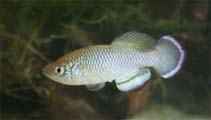 Nothobranchius oestergaardi
Male Изображение сделано Valdesalici, S.
изображения | Изображение на Google
Male Изображение сделано Valdesalici, S.
Классификация / Имена народные названия | синонимы | Catalog of Fishes(род, виды) | ITIS | CoL | WoRMS | Cloffa
> Cyprinodontiformes (Rivulines, killifishes and live bearers) > Nothobranchiidae (African rivulines)
Etymology: Nothobranchius: Greek, nothos = false + Greek, brangchia = gill (Ref. 45335); oestergaardi: The species name is dedicated to the collector and friend Kaj Østergaard, Denmark, for his contributions over a long period of time on field investigations that have led to the discovery of many new populations of Nothobranchius species in numerous countries (Ref. 86819).
Eponymy: Kaj Østergaard is a Danish friend of the authors who collected the type during a species survey in northern Zambia. [...] (Ref. 128868), visit book page.
Etymology: Nothobranchius: Greek, nothos = false + Greek, brangchia = gill (Ref. 45335); oestergaardi: The species name is dedicated to the collector and friend Kaj Østergaard, Denmark, for his contributions over a long period of time on field investigations that have led to the discovery of many new populations of Nothobranchius species in numerous countries (Ref. 86819).
Eponymy: Kaj Østergaard is a Danish friend of the authors who collected the type during a species survey in northern Zambia. [...] (Ref. 128868), visit book page.
Окружающая среда: среда / климатическая зона / пределы глубины / диапазон распространения экология
; пресноводный демерсальный; pH range: 6.1 - ?. Tropical
распространение Территории | регионы FAO | Экосистемы | места находок | карта точек | интродукции | Faunafri
Africa: an ephemeral pool in the swamps of Lake Mweru Wantipa drainage in northern Zambia (Ref. 86819, 95524).
Размер / Вес / Возраст
половая зрелость: Lm ? range ? - ? cm
Max length : 3.2 cm SL самец/пол неопределен; (Ref. 86819); 2.6 cm SL (female)
Max length : 3.2 cm SL самец/пол неопределен; (Ref. 86819); 2.6 cm SL (female)
Краткое описание определительные ключи | морфология | морфометрия
колючие лучи спинного плавника (общее число) : 0; членистые (мягкие) лучи спинного плавника (общее число) : 16 - 17; колючие лучи анального плавника: 0; членистые (мягкие) лучи анального плавника: 16 - 17; позвонки: 27. Diagnosis: Males similar to other members of Nothobranchius taeniopygus species-group, differing from all other species of Nothobranchius by caudal and anal fins having broad pale sub-marginal band and dark margin (Ref. 86819). Nothobranchius oestergaardi differs from members of N. taeniopygus species-group by the following combination of characters: proximal portion of caudal fin plain red, vs. proximally irregularly spotted in N. boklundi, N. hassoni, N. kafuensis, N. polli, N. rosenstocki, N. symoensi and N. taenipygus or caudal fin covered with spots in N. brieni and N. malaissei; dorsal fin without coloured margin, vs. black fin margin in N. rubroreticulatus or broad light blue fin margin in N. brieni, N. polli and N. symoensi; body without distinct black spots anteriorly, vs. black spots present in N. rosenstocki and N. taeniopygus; anal fin striped, vs. anal fin irregularly striped in N. hassoni and N. polli, spots concentrated on proximal portion in N. brieni, N. kafuensis, and N. malaissei, or anal fin completely marbled in N. rosenstocki and N. symoensi; distal portion of anal fin cream then light blue, vs. yellow in N. boklundi, N. polli, pale yellow to yellow white in N. taeniopygus, light blue or orange in N. kafuensis, light blue in N. rubroreticulatus and red in N. rosenstocki; and with broad dark brown border, vs. narrow dark border in N. boklundi, N. brieni, N. kafuensis, N. polli, or light blue margin in N. symoensi; distal portion of pelvic fin plain light blue, vs. spotted in N. boklundi N. brieni, N. kafuensis and N. polli, plain red in N. rosenstocki, black in N. rubroreticulatus and N. taeniopygus (Ref. 86819). Nothobranchius oestergaardi males with relatively shorter caudal peduncle compared to N. boklundi, 17.0-21.3 vs. 19.1-26.6% of standard length; shallower and longer caudal peduncle compared to N. rosenstocki, 13.6-16.0 vs. 10.1-12.9% of standard length and 17.0-21.3 vs. 12.5-14.5% of standard length respectively; shallower caudal peduncle compared to N. symoens, 13.6-16.0 vs. 12.8% of standard length; longer predorsal length compared to N. hassoni, 57.5-62.5 vs. 52.8-56.4% of standard length, N. rosenstocki, 57.5-62.5 vs. 48.3-52.9% of standard length, N. rubroreticulatus, 57.5-62.5 vs. 53.3-57.6% of standard length, and N. symoensi, 57.5-62.5 vs. 55.1% of standard length; longer prepelvic length compared to N. brieni, 49.6-52.3 vs. 43.3-45.2% of standard length, N. taeniopygus, 49.6-52.3 vs. 42.1-48.9% of standard length, and N. symoensi, 49.6-52.3 vs. 48.2% of standard length; and longer preanal length compared to N. brieni, 56.2-64.4 vs. 52.9-54.5% of standard length (Ref. 86819).
Body shape (shape guide): fusiform / normal; Cross section: oval.
Body shape (shape guide): fusiform / normal; Cross section: oval.
The type locality was at the time of collection a pond about 15 m in diameter and circa 1.5 m deep at its centre, extending on one side into the grass for about further 10 m and with a depth of 0.5 m (Ref. 86819). The aquatic vegetation consisted of a Nymphea species; the water was light clay grey and turbid, with pH 6.1 and conductivity 207 µS/cm (Ref. 86819).
Жизненный цикл и брачное поведение половая зрелость | размножение | нерест | икра | Плодовитость | личинки
Основная ссылка
Загрузите свои рекомендации | ссылки | координатор | соавторы
Valdesalici, S. and G. Amato, 2011. Nothobranchius oestergaardi (Cyprinodontiformes: Nothobranchiidae), a new annual killifish from Mweru Wantipa Lake drainage basin, northern Zambia. aqua, Int. J. Ichthyol. 17(2):111-119. (Ref. 86819)
Статус Красного Списка МСОП (Ref. 130435: Version 2025-2)
Под угрозой исчезновения (EN) (B1ab(iii)); Date assessed: 08 April 2014
CITES
Not Evaluated
Угроза для людей
Harmless
Использование человеком
рыболовство: интереса не представляет
FAO - Publication: search | FishSource |
дополнительная информация
Трофическая экология
Пищевые предметы (добыча)
состав пищи
потребление пищи
Продовольственные пайки
хищники
Пищевые предметы (добыча)
состав пищи
потребление пищи
Продовольственные пайки
хищники
Динамика численности населения
Параметры роста
Макс. возраст / размер
Отношение длины к весу.
Отношение длины к длине.
Размерный состав
Преобразование массы
пополнение
численность
Параметры роста
Макс. возраст / размер
Отношение длины к весу.
Отношение длины к длине.
Размерный состав
Преобразование массы
пополнение
численность
Жизненный цикл
размножение
половая зрелость
Зрелость/Жиры относительно.
Плодовитость
нерест
Нерестовые скопления
икра
Развитие икры
личинки
динамика численности личинок
размножение
половая зрелость
Зрелость/Жиры относительно.
Плодовитость
нерест
Нерестовые скопления
икра
Развитие икры
личинки
динамика численности личинок
Анатомия
жаберная область
Мозг
Отолит
жаберная область
Мозг
Отолит
Физиология
Состав тела
Питательные вещества
Потребление кислорода
Тип плавания
Скорость плавания
Зрительные пигменты
Звук рыбы
Болезни и паразиты
Токсичность (LC50s)
Состав тела
Питательные вещества
Потребление кислорода
Тип плавания
Скорость плавания
Зрительные пигменты
Звук рыбы
Болезни и паразиты
Токсичность (LC50s)
генетика
Геном
генетика
Гетерозиготность
наследуемость
Генетическое разнообразие
Геном
генетика
Гетерозиготность
наследуемость
Генетическое разнообразие
Связанные с человеком
Системы аквакультуры
особенности рыбоводства
степень растяжения
Случаи заболевания сигуатерой
Марки, монеты и прочее.
Системы аквакультуры
особенности рыбоводства
степень растяжения
Случаи заболевания сигуатерой
Марки, монеты и прочее.
инструменты
Специальные отчеты
Проверить содержание в аквариумах | Проверить опубликованные видовые данные | Проверить опубликованные данные по аквакультуре
Скачать в формате XML
ресурсы в Интернет
AFORO (otoliths) | Aquatic Commons | BHL | Cloffa | Websites from users | Проверить FishWatcher | CISTI | Catalog of Fishes: род, виды | DiscoverLife | ECOTOX | FAO - Publication: search | Faunafri | Fishipedia | Fishtrace | GloBI | Google Books | Google Scholar | Google | IGFA World Record | OneZoom | Open Tree of Life | Otolith Atlas of Taiwan Fishes | PubMed | Reef Life Survey | Socotra Atlas | TreeBase | Tree of Life | Wikipedia: Вперёд, поиск | World Records Freshwater Fishing | Zoobank | Зоологическая летопись
Оценки, основанные на моделях
Индекс филогенетического разнообразия (ссылка 82804): PD50 = 0.5000 [Uniqueness, from 0.5 = low to 2.0 = high].
Bayesian length-weight: a=0.01122 (0.00472 - 0.02669), b=2.94 (2.74 - 3.14), in cm total length, based on LWR estimates for this (Sub)family-body shape (Ref. 93245).
Трофический уровень (ссылка 69278): 3.1 ±0.4 se; based on size and trophs of closest relatives