



Potamotrygon amandae Loboda & Carvalho, 2013
Загрузить свой Фото и Видео
Изображение на Google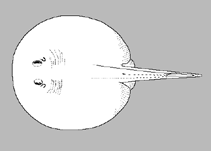 No image available for this species;
drawing shows typical species in Potamotrygonidae.
Изображение на Google
drawing shows typical species in Potamotrygonidae.
Классификация / Имена народные названия | синонимы | Catalog of Fishes(род, виды) | ITIS | CoL | WoRMS | Cloffa
Пластиножаберные (акулы и скаты) (sharks and rays) > Myliobatiformes (Stingrays) > Potamotrygonidae (River stingrays) > Potamotrygoninae
Etymology: Potamotrygon: Greek, potamos = river + Greek, trygon = a sting ray (Ref. 45335); amandae: Named for Amanda Lucas Gimeno, who was an undergraduate colleague of the first author.
Eponymy: Amanda Lucas Gimeno (1984–2006) was a Brazilian biologist who graduated (2005) from the University of São Paulo, where the senior author had been one of her undergraduate colleagues. [...] (Ref. 128868), visit book page.
Etymology: Potamotrygon: Greek, potamos = river + Greek, trygon = a sting ray (Ref. 45335); amandae: Named for Amanda Lucas Gimeno, who was an undergraduate colleague of the first author.
Eponymy: Amanda Lucas Gimeno (1984–2006) was a Brazilian biologist who graduated (2005) from the University of São Paulo, where the senior author had been one of her undergraduate colleagues. [...] (Ref. 128868), visit book page.
Окружающая среда: среда / климатическая зона / пределы глубины / диапазон распространения экология
; пресноводный донно-пелагический. Tropical
распространение Территории | регионы FAO | Экосистемы | места находок | карта точек | интродукции | Faunafri
South America: Paraná-Paraguay basin.
Размер / Вес / Возраст
половая зрелость: Lm ? range ? - ? cm
Max length : 31.2 cm WD самец/пол неопределен; (Ref. 95047); 34.1 cm WD (female)
Max length : 31.2 cm WD самец/пол неопределен; (Ref. 95047); 34.1 cm WD (female)
Краткое описание определительные ключи | морфология | морфометрия
позвонки: 113 - 129. Distinguished from other species of the genus of Potamotrygon in the Paraná-Paraguay basin, except P. motoro and P. pantanensis, by its predominantly grayish or dark brown dorsal background color usually with bicolored ocelli on dorsal disc (vs. lacking ocelli in P. falkneri, P. histrix, P. schuhmacheri, and P. brachyura; some specimens of P. amandae without ocelli and have a uniform dark brown or gray dorsal color). Can be diagnosed from P. motoro and P. pantanensis by having the following combination of characters: dorsal background predominantly grayish or dark brown (P. motoro with dorsal disc background color gray, dark gray, olive, olivaceous brown, or dark brown, and P. pantanensis with dorsal disc background brown); ocelli, when present, with two colors, with a whitish, light gray or light yellow central area surrounded by a black peripheral ring (tricolored ocelli with a peripheral dark ring, yellowish or orange center and with an intermediate band in P. motoro; bicolored ocelli with a beige, orange or dark yellow central area surrounded by a peripheral black ring in P. pantanensis); ventral disc grayish, covering almost all of ventral disc (ventral color predominantly whitish over central disc in P. motoro and P. pantanensis); dermal denticles differ from P. motoro due to their smaller size and without developed coronal plates in P. amandae and from P. pantanensis due to their distribution over almost entire dorsal side of disc (in P. motoroand P. pantanensis, dermal denticles do not cover almost entire dorsal disc); greater spiracular length compared to P. motoro and P. pantanensis, with mean 10.1% DW (ranging from 8.2 to 12.8% DW), whereas in P. motoro spiracular mean length is 8.0% DW (ranging from 6.7 to 9.8% DW), and in P. pantanensis mean spiraclular length is 8.7% DW (ranging from 7.6 to 9.6% DW); relatively longer tail, with tail length averaging 82.1% DW, whereas mean tail length is 78.5% DW in P. motoro and 73.4% DW in P. pantanensis; tail relatively more slender in P. amandae, with mean tail width 11.0% DW (ranging from 7.2 to 13.6% DW), whereas in P. motoro and P. pantanensis mean tail width is, respectively, 13.4% DW and 13.2% DW (ranging from 10.5 to 14.8% and 11.2 to 15.5% DW, respectively); frontoparietal fontanelle of neurocranium constricted at midlength (unconstricted in P. motoro and P. pantanensis), and postorbital process clearly more developed than in P. motoro and P. pantanensis; anterior angular cartilage with its medial portion at articulation with Meckel’s cartilages highly curved (J-shaped), and much greater than posterior angular cartilage (both angular cartilages subequal in P. motoro, and P. pantanensis with anterior angular cartilage rather straight, not J-shaped) (Ref. 95047).
Жизненный цикл и брачное поведение половая зрелость | размножение | нерест | икра | Плодовитость | личинки
Основная ссылка
Загрузите свои рекомендации | ссылки | координатор : Carvalho, Marcelo | соавторы
Loboda, T.S. and M.R. de Carvalho, 2013. Systematic revision of the Potamotrygon motoro (Müller & Henle, 1841) species coplex in the Paraná-Paraguay basin, with description of two new ocellated species (Chondrichthyes: Myliobatiformes: Potamotrygonidae). Neotrop. Ichthyol/ 11(4):693-737. (Ref. 95047)
Статус Красного Списка МСОП (Ref. 130435: Version 2025-2 (Global))
Не вызывающий беспокойства (LC) ; Date assessed: 03 March 2023
Угроза для людей
Harmless
Использование человеком
FAO - Publication: search | FishSource |
дополнительная информация
Трофическая экология
Пищевые предметы (добыча)
состав пищи
потребление пищи
Продовольственные пайки
хищники
Пищевые предметы (добыча)
состав пищи
потребление пищи
Продовольственные пайки
хищники
экология
экология
экология
Динамика численности населения
Параметры роста
Макс. возраст / размер
Отношение длины к весу.
Отношение длины к длине.
Размерный состав
Преобразование массы
пополнение
численность
Параметры роста
Макс. возраст / размер
Отношение длины к весу.
Отношение длины к длине.
Размерный состав
Преобразование массы
пополнение
численность
Жизненный цикл
размножение
половая зрелость
Зрелость/Жиры относительно.
Плодовитость
нерест
Нерестовые скопления
икра
Развитие икры
личинки
динамика численности личинок
размножение
половая зрелость
Зрелость/Жиры относительно.
Плодовитость
нерест
Нерестовые скопления
икра
Развитие икры
личинки
динамика численности личинок
Анатомия
жаберная область
Мозг
Отолит
жаберная область
Мозг
Отолит
Физиология
Состав тела
Питательные вещества
Потребление кислорода
Тип плавания
Скорость плавания
Зрительные пигменты
Звук рыбы
Болезни и паразиты
Токсичность (LC50s)
Состав тела
Питательные вещества
Потребление кислорода
Тип плавания
Скорость плавания
Зрительные пигменты
Звук рыбы
Болезни и паразиты
Токсичность (LC50s)
генетика
Геном
генетика
Гетерозиготность
наследуемость
Генетическое разнообразие
Геном
генетика
Гетерозиготность
наследуемость
Генетическое разнообразие
Связанные с человеком
Системы аквакультуры
особенности рыбоводства
степень растяжения
Случаи заболевания сигуатерой
Марки, монеты и прочее.
Системы аквакультуры
особенности рыбоводства
степень растяжения
Случаи заболевания сигуатерой
Марки, монеты и прочее.
инструменты
Специальные отчеты
Проверить содержание в аквариумах | Проверить опубликованные видовые данные | Проверить опубликованные данные по аквакультуре
Скачать в формате XML
ресурсы в Интернет
AFORO (otoliths) | Aquatic Commons | BHL | Cloffa | Websites from users | Проверить FishWatcher | CISTI | Catalog of Fishes: род, виды | DiscoverLife | ECOTOX | FAO - Publication: search | Faunafri | Fishipedia | Fishtrace | GloBI | Google Books | Google Scholar | Google | IGFA World Record | OneZoom | Open Tree of Life | Otolith Atlas of Taiwan Fishes | PubMed | Reef Life Survey | Socotra Atlas | TreeBase | Tree of Life | Wikipedia: Вперёд, поиск | World Records Freshwater Fishing | Zoobank | Зоологическая летопись
Оценки, основанные на моделях
Индекс филогенетического разнообразия (ссылка 82804): PD50 = 0.5000 [Uniqueness, from 0.5 = low to 2.0 = high].
Bayesian length-weight: a=0.01000 (0.00244 - 0.04107), b=3.04 (2.81 - 3.27), in cm total length, based on all LWR estimates for this body shape (Ref. 93245).
Трофический уровень (ссылка 69278): 3.2 ±0.4 se; based on size and trophs of closest relatives