-

- Acerca de esta página
- Idiomas
- Opiniones de los usuarios
- Citación
- Carga
- Especies relacionadas
-



Dichichthys satoi White, Stewart, O’Neill & Naylor, 2024
Roughback bristle shark
Sube tu fotos y Vídeos
Google image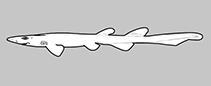 No image available for this species;
drawing shows typical species in Dichichthyidae.
Google image
drawing shows typical species in Dichichthyidae.
Clasificación / Nombres Nombres comunes | Sinónimos | Catalog of Fishes(Género, Especie) | ITIS | CoL | WoRMS | Cloffa
Elasmobranquios (tiburones y rayas) (sharks and rays) > Carcharhiniformes (Ground sharks) > Dichichthyidae (Bristle shark)
Etymology: Dichichthys: Name from the combination of the Greek 'dicho'- meaning 'to branch in two' and 'ichthys' for 'fish', with this genus being intermediate between the Galeus-Parmaturus complex and Apristurus; satoi: Named after Dr Keiichi Sato (Okinawa Churaumi Aquarium), whose extensive work on the taxonomy of deepwater catsharks has been crucial for the field.
Etymology: Dichichthys: Name from the combination of the Greek 'dicho'- meaning 'to branch in two' and 'ichthys' for 'fish', with this genus being intermediate between the Galeus-Parmaturus complex and Apristurus; satoi: Named after Dr Keiichi Sato (Okinawa Churaumi Aquarium), whose extensive work on the taxonomy of deepwater catsharks has been crucial for the field.
Entorno: milieu / zona climática / rango de profundidad / gama de distribución Ecología
marino batidemersal; rango de profundidad 666 - 1175 m (Ref. 130868). Subtropical; 32°S - 40°S (Ref. 130868)
Distribución Territorios | Áreas FAO | Ecosistemas | Ocurrencias, apariciones | Mapa de puntos | Introducciones | Faunafri
Southwest Pacific: New Zealand.
Tamaño / Peso / Edad
Madurez: Lm ? range ? - ? cm
Max length : 97.3 cm TL macho / no sexado; (Ref. 130868); 104.6 cm TL (female)
Max length : 97.3 cm TL macho / no sexado; (Ref. 130868); 104.6 cm TL (female)
Descripción breve Claves de identificación | Morfología | Morfometría
Vértebra: 133 - 143. This large bristle shark is distinguished by the following set of characters: preanal length, 58.1-62.1% TL; pre-first dorsal length, 50.5-53.4% TL; prenarial length is moderately long, 4.0-5.2% TL; head is depressed, its height 0.6-1.1 times its width; mouth is moderately wide, its width 9.0-11.4% TL; lower labial furrows is distinctly longer than uppers (uppers 1.4-2.0% TL, lowers 2.0-2.8% TL); anal-fin is moderately large, its base 11.0-12.0% TL, posterior margin, 5.4-7.4% TL; pectoral–pelvic space, 21.2-26.1% TL; teeth in 102-106 files in upper jaw and ca. 94-101 lower jaw; vertebrae: monospondylous centra, 45-47; precaudal centra, 95-101; total centra, 133-143; body uniformly medium brown to greyish brown; fins with white margins, variable but mostly broad; (Ref. 130868).
Cross section: oval.
Cross section: oval.
The stomach of the gravid female paratype (CSIRO H 9287-01), from which the reproductive
tract was removed, contained one 40.0-45.0 cm long whiptail, Coelorinchus trachycarus
and beaks of two octopus, Muusoctopus clyderoperi. The females examined ranged from 63.7-104.6 cm TL, smallest mature female was 97.1 cm TL. The males examined ranged from 63.2-97.3 cm TL, smallest mature male was 85.6 cm TL; two males of 632 and 642 mm TL have immature claspers with no evidence of maturation beginning (Ref. 130868).
Ciclo vital y comportamiento de apareamiento Madurez | Reproducción | Puesta | Huevos | Fecundidad | Larva
Referencia principal
Suba sus referencias | Referencias | Coordinador | Colaboradores
White, W.T., A.L. Stewart, H.L. O’Neill and G.J.P. Naylor, 2024. Dichichthyidae, a new family of deepwater sharks (Carcharhiniformes) from the Indo–West Pacific, with description of a new species. Fishes 2024, 9, 121. (Ref. 130868)
Situación en la Lista Roja de la UICN (Ref. 130435: Version 2025-2)
Data deficient (DD) ; Date assessed: 30 April 2024
CITES
Not Evaluated
Amenaza para el ser humano
Harmless
Usos humanos
FAO - Publication: search | FishSource |
Más información
Ecología Trófica
Alimentos (presas)
Composición de la dieta
consumo de alimento
Raciones de comida
Despredadores
Alimentos (presas)
Composición de la dieta
consumo de alimento
Raciones de comida
Despredadores
Ecología
Ecología
Ecología
Dinámica de la población
Coeficiente del crecimiento para
Edades / tallas máximas
Longitud-peso rel.
Longitud-longitud rel.
Longitud-frecuencias
Conversión de masas
Reclutamiento
Abundancia
Coeficiente del crecimiento para
Edades / tallas máximas
Longitud-peso rel.
Longitud-longitud rel.
Longitud-frecuencias
Conversión de masas
Reclutamiento
Abundancia
Ciclo de vida
Reproducción
Madurez
Madurez/Gills rel.
Fecundidad
Puesta
Agregaciones de desove
Huevos
Desarrollo de los huevos
Larva
Dinámica larvaria
Reproducción
Madurez
Madurez/Gills rel.
Fecundidad
Puesta
Agregaciones de desove
Huevos
Desarrollo de los huevos
Larva
Dinámica larvaria
Distribución
Territorios
Áreas FAO
Ecosistemas
Ocurrencias, apariciones
Introducciones
BRUVS - Vídeos
Territorios
Áreas FAO
Ecosistemas
Ocurrencias, apariciones
Introducciones
BRUVS - Vídeos
Anatomía
Superficie branquial
Cerebro
Otolito
Superficie branquial
Cerebro
Otolito
Fisiología
Composición corporal
Nutrientes
Consumo del oxígeno
Tipo de natación
Velocidad de natación
Pigmentos visuales
Sonido de peces
Enfermedades y parásitos
Toxicidad (CL50)
Composición corporal
Nutrientes
Consumo del oxígeno
Tipo de natación
Velocidad de natación
Pigmentos visuales
Sonido de peces
Enfermedades y parásitos
Toxicidad (CL50)
Genética
Genoma
Genética
Heterocigosidad
heritabilidad
Diversidad genética
Genoma
Genética
Heterocigosidad
heritabilidad
Diversidad genética
Relacionados con el ser humano
Sistemas de acuicultura
Perfiles de acuicultura
Razas
Ciguatera cases
Sellos, monedas, varios
Sistemas de acuicultura
Perfiles de acuicultura
Razas
Ciguatera cases
Sellos, monedas, varios
Herramientas
Libro electrónico | Guía de campo | Asistente para frecuencias de tallas | Herramienta de ciclo de vida | Mapa de puntos |
Catch-MSY |
Informes especiales
Comprobar el mantenimiento del acuario | Buscar fichas sobre especies | Consulte las hojas informativas sobre acuicultura
Descargar XML
Fuentes de Internet
AFORO (otoliths) | Aquatic Commons | BHL | Cloffa | Websites from users | Check FishWatcher | CISTI | Catalog of Fishes: Género, Especie | DiscoverLife | ECOTOX | FAO - Publication: search | Faunafri | Fishipedia | Fishtrace | GloBI | Google Books | Google Scholar | Google | IGFA World Record | OneZoom | Open Tree of Life | Otolith Atlas of Taiwan Fishes | PubMed | Reef Life Survey | Socotra Atlas | TreeBase | Árbol de la vida | Wikipedia: Go, búsqueda | World Records Freshwater Fishing | Zoobank | Expediente Zoológico