



Lägg till din observation i Fish Watcher
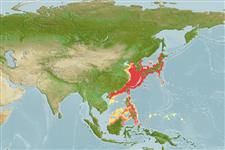
| Native range | All suitable habitat | Point map | Year 2050 |
|
| This map was computer-generated and has not yet been reviewed. |
| Engraulis japonicus AquaMaps Data sources: GBIF OBIS |
Ladda upp din foton och Videor
Bilder | Google image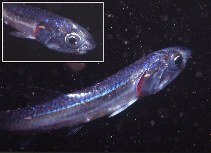 Engraulis japonicus
Bild av Zsilavecz, G.
Bilder | Google image
Bild av Zsilavecz, G.
Klassificering / Namn Populärnamn | synonymer | Catalog of Fishes(Släkte, Arter) | ITIS | CoL | WoRMS | Cloffa
> Clupeiformes (Herrings) > Engraulidae (Anchovies) > Engraulinae
Etymology: Engraulis: Greek, eggraulis, -eos = anchovy (Ref. 45335).
More on authors: Temminck & Schlegel.
Etymology: Engraulis: Greek, eggraulis, -eos = anchovy (Ref. 45335).
More on authors: Temminck & Schlegel.
Miljö: miljö / Klimatzon / djupintervall / distributionsområde Ekologi
marina pelagic-neritic; havsvandrande (Ref. 51243); djupintervall 0 - 400 m (Ref. 50550). Temperate; 8°C - 30°C (Ref. 56557); 49°N - 2°N, 105°E - 155°E (Ref. 54432)
Utbredning Territorier | FAO områden | Ekosystem | Förekomster | Prickkarta | Utplanteringar | Faunafri
Western Pacific: southern Sakhalin Islands, Sea of Japan and Pacific coasts of Japan, and south to almost Canton/Taiwan; rare records (seems to represent stray fishes) off the coasts of Luzon and Western Mindanao, Philippines and from Manado and Ujung Pandang, Sulawesi, Indonesia (Ref. 189).
Längd vid första mognad / Storlek / Vikt / Ålder
Könsmognad: Lm 10.5, range 10 - 11 cm
Max length : 18.0 cm TL hane/ej könsbestämd; (Ref. 56527); common length : 14.0 cm TL hane/ej könsbestämd; (Ref. 56527); publicerad maxvikt: 45.00 g (Ref. 56527); rapporterad maxålder: 4 år (Ref. 56527)
Max length : 18.0 cm TL hane/ej könsbestämd; (Ref. 56527); common length : 14.0 cm TL hane/ej könsbestämd; (Ref. 56527); publicerad maxvikt: 45.00 g (Ref. 56527); rapporterad maxålder: 4 år (Ref. 56527)
Kort beskrivning Bestämningsnycklar | Morfologi | Morfometri
Taggstrålar i ryggfenan (totalt) : 0; Mjukstrålar i ryggfenan (totalt) : 12 - 14; Taggstrålar i analfenan: 0; Mjukstrålar i analfenan: 13 - 18. Differs very little from the European anchovy (see E. encrasicolus) and can be identified from that description. Of other anchovies found in the southern part of its distribution, only species of Encrasicholina and Stolephorus are of similar appearance, but all have small spine-like pre-pelvic scutes (usually 2 to 7 scutes). Thryssa have compressed bodies and a keel of scutes along belly.
Body shape (shape guide): elongated; Cross section: oval.
Body shape (shape guide): elongated; Cross section: oval.
Occurs in large schools near the surface, mainly in coastal waters but as far out as over 1,000 km from the shore. Tends to move more northward and inshore in spring and summer. Juveniles associate with drifting seaweed (Ref. 12114, 12115). Feeds on copepods, but also on other small crustaceans, molluscan larvae, fish eggs and larvae and diatoms. Marketed fresh and salted, processed into fishmeal and oil (Ref. 12484).
Livscykel och parningsbeteende Könsmognad | Reproduktion | Lek | Ägg | Fekunditet | Larver
Huvudreferens
Ladda upp dina referenser | referenser | Koordinator | Medarbetare
Whitehead, P.J.P., G.J. Nelson and T. Wongratana, 1988. FAO Species Catalogue. Vol. 7. Clupeoid fishes of the world (Suborder Clupeoidei). An annotated and illustrated catalogue of the herrings, sardines, pilchards, sprats, shads, anchovies and wolf-herrings. FAO Fish. Synop. 125(7/2):305-579. Rome: FAO. (Ref. 189)
Status på IUCN:s rödlista (Ref. 130435: Version 2025-2 (Global))
Least Concern (LC) ; Date assessed: 16 May 2018
CITES
Not Evaluated
Hot mot människor
Reports of ciguatera poisoning (Ref. 4690)
Mänskliga användningsområden
Fiskeri: kommersiellt viktig; Vattenbruk: kommersiell; bete: usually
FAO - fiskeri: landningar, artprofil; Publication: search | FishSource | Havet omkring oss
Ytterligare information
Populationsdynamik
Tillväxtparametrar
Max. åldrar / storlekar
Längd-vikt rel.
Längd-längd rel.
Längd-frekvenser
Massakonvertering
Rekrytering
Abundans
Tillväxtparametrar
Max. åldrar / storlekar
Längd-vikt rel.
Längd-längd rel.
Längd-frekvenser
Massakonvertering
Rekrytering
Abundans
Livscykel
Reproduktion
Könsmognad
Mognad/Gills rel.
Fekunditet
Lek
Lekande aggregat
Ägg
Utveckling av ägg
Larver
Larvdynamik
Reproduktion
Könsmognad
Mognad/Gills rel.
Fekunditet
Lek
Lekande aggregat
Ägg
Utveckling av ägg
Larver
Larvdynamik
Anatomi
Gälyta
Hjärna
Otolit
Gälyta
Hjärna
Otolit
Fysiologi
Kroppssammansättning
Näringsämnen
Syreförbrukning
Typ av simning
Simhastighet
Visuella pigment
Ljud från fisk
Sjukdomar & Parasiter
Toxicitet (LC50)
Kroppssammansättning
Näringsämnen
Syreförbrukning
Typ av simning
Simhastighet
Visuella pigment
Ljud från fisk
Sjukdomar & Parasiter
Toxicitet (LC50)
Människorelaterad
Vattenbrukssystem
Vattenbruksprofiler
Avelslinjer
Ciguatera-fall
Frimärken, mynt, diverse.
Vattenbrukssystem
Vattenbruksprofiler
Avelslinjer
Ciguatera-fall
Frimärken, mynt, diverse.
Verktyg
Organisk frågesport | E-bok | Fälthandbok | Bestämningsnycklar | Längdfördelnings-verktyg | Livshistorie-verktyg | Prickkarta |
Fångst-MSY |
Särskilda rapporter
Kontrollera för underhåll av akvarium | Kontrollera om det finns faktablad om arter | Kontrollera om det finns faktablad om vattenbruk
Ladda ner XML
Internet-källor
AFORO (otoliths) | Aquatic Commons | BHL | Cloffa | Websites from users | Check FishWatcher | CISTI | Catalog of Fishes: Släkte, Arter | DiscoverLife | ECOTOX | FAO - fiskeri: landningar, artprofil; Publication: search | Faunafri | Fishipedia | Fishtrace | GloBI | Google Books | Google Scholar | Google | IGFA World Record | Nationella databaser | OneZoom | Open Tree of Life | Otolith Atlas of Taiwan Fishes | PubMed | Reef Life Survey | Socotra Atlas | TreeBase | Tree of Life | Wikipedia: Go, sök | World Records Freshwater Fishing | Zoobank | Zoologiskt register
Uppskattningar baserade på modeller
Önskad temperatur (Ref. 123201): 8.1 - 23.3, mean 18.4 °C (based on 139 cells).
Index för fylogenetisk mångfald (Ref. 82804): PD50 = 0.5020 [Uniqueness, from 0.5 = low to 2.0 = high].
Bayesian length-weight: a=0.00389 (0.00263 - 0.00576), b=3.10 (2.98 - 3.22), in cm total length, based on LWR estimates for this species & Genus-body shape (Ref. 93245).
Trofisk nivå (Ref. 69278): 3.1 ±0.1 se; based on diet studies.
Generation time: 1.1 (1.0 - 1.8) years. Estimated as median ln(3)/K based on 16 growth studies.
Resiliens (Ref. 120179): Hög, lägsta populationsfördubblingstid mindre än 15 månader (K=1.05; tm=1-2; tmax=3).
Prior r = 0.90, 95% CL = 0.60 - 1.36, Based on 3 full stock assessments.
Näringsämnen (Ref. 124155): Calcium = 148 [56, 380] mg/100g; Iron = 0.698 [0.304, 1.783] mg/100g; Protein = 18.3 [16.8, 19.7] %; Omega3 = 1.57 [0.74, 3.39] g/100g; Selenium = 14.9 [5.6, 40.7] μg/100g; VitaminA = 7.51 [1.30, 42.67] μg/100g; Zinc = 0.939 [0.527, 1.630] mg/100g (wet weight);